

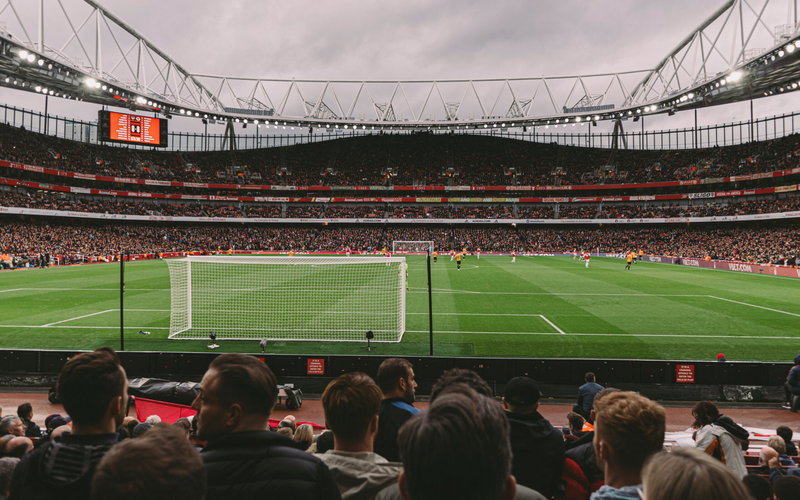
Arsenal have enough attacking quality to make another step forward in 2026/27. The main opportunity is tactical: create shots earlier after regains, place more runners inside the box and become less predictable against teams defending with a low block.
That matters when analysing potentially high-scoring fixtures or over 4.5 goals predictions today. Arsenal can increase the probability of open matches when their press creates immediate attacks rather than another long possession sequence. For Arteta, the priority is turning control into clearer chances.
Arsenal’s Attacking Platform for 2026/27
Arsenal already have several ways to progress the ball. Bukayo Saka can receive wide or move into the right half-space, Martin Ødegaard can operate between the lines, Declan Rice can advance from deeper positions and Viktor Gyökeres provides a direct threat behind centre-backs.
The wider online football audience may also interact with entertainment products such as Tom Horn gaming, but the sporting question is much narrower. Arsenal need to make those individual profiles work simultaneously. If Saka comes inside, another player must provide width. If Gyökeres drops, somebody must attack the space he leaves behind.
This coordination determines the quality of Arsenal’s chance creation. Having five players around the penalty area is useful only when they occupy different zones and force defenders to make decisions.
Where Arsenal Can Still Improve
Arsenal’s biggest attacking gains can come from five specific adjustments:
- Attack immediately after regains: play forward before the opposition restores its defensive shape.
- Increase runs behind the defence: prevent centre-backs from stepping into midfield without consequences.
- Use more cutbacks: reach the byline and target runners arriving around the penalty spot.
- Improve weak-side occupation: keep a player ready to attack the far post when the move develops on the opposite flank.
- Move the ball faster against low blocks: force the defensive unit to shift repeatedly before attacking the resulting gap.
The low-block problem deserves particular attention. Slow circulation allows defenders to move together. Arsenal need to move opponents first and attack the space second.
One useful pattern is an overload on Saka’s side. Saka, Ødegaard and a supporting full-back can attract several defenders towards the right. Arsenal can then switch quickly to the opposite winger before the defensive block moves across.
Another solution is the third-man run. Gyökeres can drop towards midfield, receive or simply occupy a centre-back, while a midfielder attacks the space behind him. That creates vertical movement instead of having every attacker receive with his back to goal.
More Goals From Different Areas
A stronger Arsenal attack cannot depend entirely on the centre-forward. Gyökeres should remain the main penalty-area reference, but his positioning can also create shots for Saka, midfield runners and the opposite winger.
The mechanism is simple. If Gyökeres attacks the near post, the nearest centre-back follows him. A second Arsenal player attacks the central space and the weak-side winger moves towards the far post. A midfielder stays slightly deeper for the cutback.
One cross or low pass can therefore have four targets at different depths.
Wide Players and Midfield Runners
Saka becomes particularly difficult to defend when Arsenal give him alternatives. An overlapping run can pull the full-back outside. An underlapping midfielder can attack inside. Saka can then dribble, combine centrally or release the runner.
The same principle should operate on the opposite flank. Arsenal become predictable if most attacks finish on the right. Switching the ball quickly after creating an overload can isolate the weak-side winger against one defender.
Midfield timing matters too. Rice or another midfielder arriving late is harder to track than a player already standing inside the box. The runner can attack cutbacks while defenders remain occupied by Gyökeres.
What Arsenal’s Greatest Attacks Got Right
Arsenal’s best historical sides provide a useful lesson because their attacking threat rarely came from one player.
The 1988/89 champions produced one of the club’s defining attacking moments at Anfield. Arsenal needed a two-goal victory over Liverpool on the final day. Alan Smith made it 1-0 before Michael Thomas ran through midfield to score the title-winning second goal in stoppage time.
Wenger’s teams later made attacking variety part of Arsenal’s identity. The 2003/04 Invincibles could threaten through Thierry Henry’s acceleration, Dennis Bergkamp’s movement between the lines, Robert Pires attacking from the left and Freddie Ljungberg making runs beyond the forwards.
The important lesson for Arsenal 2026/27 is not nostalgia. It is the number of simultaneous threats.
Henry could move away from the centre and another player would attack the space. Bergkamp could drop deeper without leaving the penalty area empty. Pires and Ljungberg provided goals without playing as conventional centre-forwards.
Arteta needs the modern version of that principle: Gyökeres stretching the defence, Saka creating from the right, another winger threatening the far side and midfielders attacking spaces created by the forwards.
Tactical Changes That Could Raise Arsenal’s Ceiling
Five patterns could make Arsenal harder to defend:
- Right-side overload: combine Saka, a midfielder and full-back to create a three-versus-two.
- Fast switch: move immediately from an overloaded flank towards an isolated winger.
- Winger and full-back rotation: alternate which player stays wide and which attacks the half-space.
- Three-lane box occupation: attack the near post, centre and far post with separate runners.
- Vertical counter-press: after recovering possession high, look towards goal before recycling the ball.
The three-lane structure is particularly important. Attackers should not arrive in the same area. Gyökeres can attack the front zone, another runner occupies the centre and the opposite winger attacks behind the far-side defender.
Arsenal also need to recognise when not to build patiently. A high regain against a disorganised defence is often more valuable than another minute of possession. The first thought after winning the ball should be whether a vertical pass is available.
What Could Limit Arsenal’s Attack?
The first risk is predictability. If attacks repeatedly travel through Saka before finishing with the same combination, opponents can overload that side and protect the inside channel.
The second is finishing. Better structures create better opportunities, but they do not guarantee goals. Arsenal still need efficient execution inside the box.
Squad availability can also change the system. A missing winger removes one-versus-one ability, while the absence of a creative midfielder reduces combinations between the lines. Depth matters because replacements must reproduce functions, not simply fill positions.
There is also a defensive trade-off. Sending five players into the final third leaves fewer players protecting turnovers. Arsenal therefore need strong rest defence behind attacks, especially against opponents with quick forwards.
Conclusion
Arsenal can become more dangerous in 2026/27 without rebuilding their attacking system. The clearest improvements are faster attacks after regains, better movement against low blocks, stronger far-post occupation, more midfield runs and quicker switches after wide overloads. Arsenal’s greatest attacking sides offer the same basic lesson: one dangerous player can be controlled, but several coordinated threats are much harder to stop.
Image Source: unsplash.com