


A Tale of Two Prodigies: Max Dowman and Dennis Bergkamp
The world of football is constantly on the lookout for the next great talent, and Arsenal, a club with a rich history of nurturing young stars, finds itself at the centre of this conversation once again. The name on everyone’s lips is Max Dowman, a prodigious talent whose recent Premier League debut has drawn comparisons to one of the club’s most iconic figures, Dennis Bergkamp. While the comparison is a testament to Dowman’s immense potential, it’s also a fascinating exercise in examining the different paths to professional success and the changing landscape of football. This is not simply a comparison of two players, but of two eras.
The First Steps: Ages of Breakthrough and Impact
The most striking difference between the two players is the sheer age at which they broke into the senior game and the statement they made. Dennis Bergkamp was given his professional debut by the legendary Johan Cruyff at Ajax on December 14, 1986, at the age of 17 years and 7 months. His breakthrough was a gradual process. He made 23 appearances in his first season, including his European debut, but it was in the following years that he truly established himself. By the 1990-91 season, he had become the Eredivisie’s joint top scorer, marking his statement of intent as a truly world-class talent. His arrival at Arsenal in 1995 was not as a raw teenager, but as a seasoned international and two-time Dutch Footballer of the Year. He was brought in to make an immediate impact, a testament to his established pedigree.
Max Dowman’s professional debut is an entirely different story. He became the second-youngest player in Premier League history, making his first appearance at 15 years and 235 days old. His brief but electric cameo wasn’t just a token gesture; it was a statement. He entered the field with an air of confidence far beyond his years, showcasing his dribbling ability and, most memorably, winning a late penalty. The instant impact he had on the game, creating a buzz of anticipation with every touch, is what has captivated fans and pundits alike. This level of immediate, high-stakes exposure for a player so young is a modern phenomenon, reflecting a club’s willingness to bet on generational talent even before their physical and mental development is complete.

The Role of Academy and Coaching Philosophies
The developmental journey of both players is a direct reflection of the coaching philosophies that shaped them. Dennis Bergkamp was a product of the fabled Ajax academy, a system steeped in the principles of “Total Football”. Under the guidance of luminaries like Johan Cruyff, the academy focused on producing players with extraordinary game intelligence and versatility. Every player, regardless of their natural position, was trained to be comfortable anywhere on the pitch. This approach instilled in Bergkamp the tactical awareness to know where and when to move, and the technical skill to execute his vision. He learned to be a “complete” footballer, a trait that would later define his genius.
In contrast, Max Dowman has been developed through Arsenal’s Hale End academy, a modern system that combines technical coaching with cutting-edge science. The philosophy here is about creating a well-rounded athlete, both on and off the pitch. Coaches have not only honed Dowman’s technical skills but have also emphasised the psychological and physical readiness required for the modern game. This includes advanced analytics, nutrition plans, and sports psychology, all aimed at fast-tracking a player’s readiness for the Premier League’s intense demands.
The Influence of Family and Upbringing
A crucial difference between the two lies in their family backgrounds, which have shaped their approach to the game. Dennis Bergkamp’s upbringing was one of grounded humility. His father, a former amateur footballer, ensured that football remained a passion and not an all-consuming profession from a young age. The family prioritised his education and a normal, balanced childhood, which is often cited as a reason for Bergkamp’s reserved, professional demeanour. He was famously not an extrovert, but a perfectionist who let his actions on the pitch speak for themselves. This environment fostered a deep love for the craft and a meticulous work ethic.
Max Dowman, on the other hand, is a product of the modern footballing family. His family has been an integral and proactive part of his journey from a very young age, navigating the complexities of academy life, media attention, and the hyper-professionalised world of youth football. This support system is key to his poise and confidence at such a young age. However, it also means his journey is one under constant scrutiny, a challenge Bergkamp did not face until he became a global star. Dowman’s family’s role is not just about emotional support but also about managing a budding career, a significant evolution from the simpler, less commercialised era Bergkamp grew up in.
Physical and Mental Development: The Great Divide
The physical and mental journey of these two players is arguably where the biggest difference lies. Bergkamp had the luxury of a gradual ascent, making his senior debut at 17 but having several years at Ajax and a challenging spell at Inter Milan to build his physical strength and mental resilience. His time in Italy, although difficult, forced him to toughen up and develop a winning mentality in a ruthless environment.
Max Dowman, at just 15, is a different case entirely. He is a schoolboy operating in a man’s world. His body is still developing, and the club’s careful management of his physical load is paramount to prevent injury. The mental challenge is even greater. He is a talent in the age of social media, where a single good dribble can lead to a deluge of hype and a single mistake can result in vicious criticism. The focus for Arsenal is on building a supportive environment that shields him from this pressure, allowing him to grow without the burden of unrealistic expectations.
Style of Play and Tactical Impact
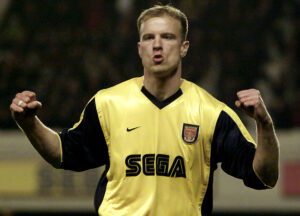
Dennis Bergkamp’s style of play was a masterclass in elegance, intelligence, and technique. He was a second striker or attacking midfielder who operated in a free role, a “false 9” before the term became commonplace. His vision, first touch, and spatial awareness were legendary. He was a player who could not only score stunning goals but also create them with a sublime pass or a clever piece of movement. His arrival at Arsenal in 1995 was a tactical inflection point. With Arsène Wenger’s arrival, Bergkamp became the heart of a new, revolutionary system. He was the on-field orchestra-tor who helped transform Arsenal into the team known for its “beautiful football,” making his teammates, most notably Thierry Henry, better players.
While it is still early to make definitive statements about Max Dowman’s style, his brief appearances have offered tantalising glimpses. He has been praised for his ball-carrying ability, his quick feet, and his positive, direct approach. He plays with a freedom and joy that is reminiscent of a young Lionel Messi, a comparison that has been made by former players like Theo Walcott. Like Bergkamp, he possesses an innate ability to glide past players and create something out of nothing. Dowman enters an Arsenal team that is already a tactical masterpiece under Mikel Arteta. His role wouldn’t be to revolutionise the team, but to add a new layer of dynamism. His exceptional ball-carrying and dribbling ability offer a unique threat that can break down low blocks and create chaos in the final third. He can operate in a number of roles—as a creative number 8, a fluid winger, or even a roaming forward—complementing players like Martin Ødegaard and Bukayo Saka and offering Arteta a different tactical solution when needed.
Legacy and Expectations
Dennis Bergkamp’s legacy at Arsenal is more than just trophies; it is a symbol of a paradigm shift. He embodied the club’s transition from a pragmatic, defensive side to one of the most aesthetically pleasing teams in the world. He became the benchmark for a generation of attacking players. His impact was so profound that a statue was erected in his honour at the Emirates Stadium.
For Max Dowman, the expectations must be grounded in reality. He should not be seen as the “next Bergkamp” but rather the first of his kind—a modern prodigy from the Hale End academy, shaped by data-driven development and a holistic approach. His success will be a testament to Arsenal’s current blueprint for nurturing talent. The focus should be on his continued growth, giving him the space and time to fulfil his immense potential. The journey is just beginning, and while the comparisons are a nod to his talent, his story will be his own.
Ultimately, the comparison between Max Dowman and Dennis Bergkamp is not about who is better, or who will achieve more. It is about understanding the evolution of football itself. Bergkamp’s legacy is one of transformation—a player who elevated a club from pragmatism to artistry, defining a golden age. Dowman’s journey, if successful, will be a testament to a different kind of excellence: the culmination of a scientific, data-driven approach to nurturing talent. While he may not be the “Next Bergkamp,” he has the potential to become a symbol for the modern Arsenal—a club built on homegrown talent, tactical fluidity, and a relentless pursuit of the beautiful game. The comparisons will continue, but the real story is just beginning to be written.
Images courtesy of Reuters/Action Images