

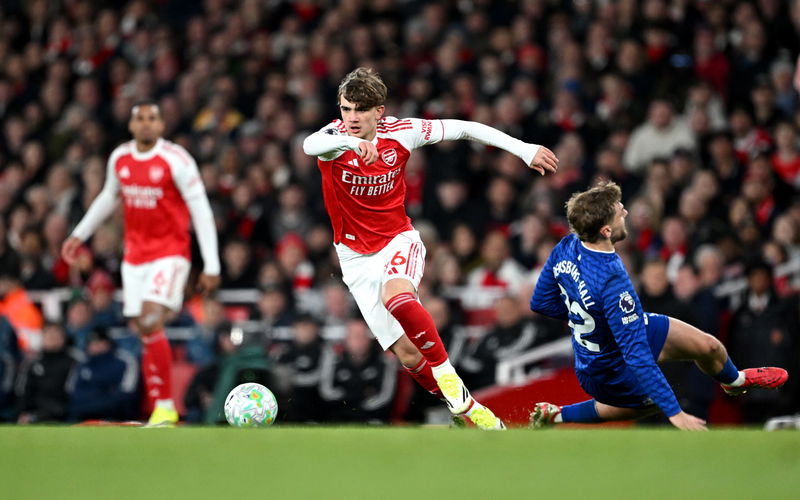
For months, a tiring, reductive, and frankly lazy narrative has been gestating in the labs of the British sports media and among certain “legacy” pundits. The accusation levelled at Mikel Arteta’s Arsenal is that they are “killing the game.” They call it boring. They call it anti-football. John Obi Mikel, the former Chelsea midfielder, even went as far as to label the Gunners “cheaters”—as if being more prepared, more physical, and more clinical at set-pieces is somehow a subversion of the laws of the game rather than a brilliant evolution of the sport.
But on Saturday, March 14, 2026, at 17:30 PM, the Emirates Stadium didn’t play host to a “boring” funeral. It hosted a masterclass. Against David Moyes’ notoriously stubborn, low-block Everton side, we saw the intersection of Arteta’s tactical rigidity and the pure, unadulterated joy of Hale End. It was a game that didn’t just yield three points; it yielded a moment of history that effectively silenced the negative coverage of the London press and left the blue half of Merseyside in awe of a 16-year-old schoolboy.
The intellectual defence: Arteta vs. The Press
Prior to the game, in his pre-match media conference, Mikel Arteta was grilled on how his team is being judged. The narrative-driven questions attempted to paint his side in a bad light, focusing on “dark arts” and the perceived “ugliness” of set-piece dominance. Arteta, as he often does, responded with a level of intelligence that most pundits seem to lack. He didn’t just defend his team; he challenged the media’s very understanding of the modern game and where the Premier League is heading.
Arteta used a fascinating example: the midweek Champions League clash between Newcastle United and Barcelona. Here was Barça—the high priests of Tiki-Taka, a team built on the foundation of 80% possession—forced to change their entire identity against a relentless, physical Newcastle side. Arteta’s point was sharp and resonant:
“Teams train to play a certain way, but that doesn’t mean the opposition will allow you to play. You have to find a way to win when the door is slammed shut.”
In a Premier League that is increasingly a tactical arms race, being “pretty” is a luxury; being “effective” is the mandate. If one of the best footballing clubs in the world can be forced out of their rhythm by a physical English side, why is it a crime when Arsenal uses their own physicality to dominate? Arteta was talking about the overall context of the league—a league where everyone is fit, everyone is tactical, and nobody gives you an inch for free.
The Hypocrisy of the “City Bias”
The double standard in the media becomes glaringly obvious when you look at the blue side of Manchester. On the same Saturday, Manchester City—the media’s darlings of “pure” football—struggled to a draw against West Ham at the London Stadium. Pep Guardiola’s side left that game with 15 corners and 16 throw-ins.
Yet, as we scrolled through the Sunday papers and refreshed the sports apps, where were the articles accusing City of “killing the game” because they couldn’t score from open play? Where were the cries of “boring” when they failed to convert those eighteen-yard box situations? There was total silence. The reality is that the media only complains about the importance of set-pieces when Arsenal is the one using them to win. It isn’t that City doesn’t try to use these situations; it’s simply that they aren’t as good as Arsenal at scoring from them. Success, it seems, breeds resentment in the press box.
A history-maker in GCSEs: The Max Dowman show
The narrative of Arsenal being a “set-piece merchant” team was shattered on Saturday not by a towering header from a centre-back, but by a 16-year-old boy from Chelmsford.
The match itself was a tactical and strategic feast. For 60 minutes, fans saw two of the best-defended teams in the league going toe-to-toe. It was high-level chess. But in the second half, the atmosphere shifted. Both sets of fans were happy with the spectacle as the game opened up, but nobody expected what came next.
Max Dowman, a young man currently navigating his GCSE exams, walked onto the Emirates turf for a 30-minute cameo and didn’t just play—he masterminded a 2-0 victory. This wasn’t a “run around and get experience” substitution; this was a “take the game by the sleeve” performance.
His impact was immediate and devastating. In the 89th minute, Dowman showcased a level of vision usually reserved for veterans. He delivered a cross of such curving perfection that it left England’s number one, Jordan Pickford, stranded in no-man’s-land. The ball found Piero Hincapié, who expertly set up Viktor Gyökeres for a tap-in. The roof nearly came off the Emirates, but the best was yet to come.
The “Glide” That shook the world
In stoppage time, the moment occurred that has now got everyone talking and rewinding their screens over and over. Collecting the ball, Dowman embarked on a run that can only be described as a “glide.” With a silky, tricky foot-walk that looked like he was dancing on glass, he skipped past the Everton midfield. One Everton defender was left literally face-palming in frustration as Dowman’s footwork left him in the dust.
When he slotted the ball home to make it 2-0, he wasn’t just scoring a goal; he was making a whole stadium’s dream become a reality. At 16 years and 73 days old, Max Dowman became the youngest goalscorer in Premier League history.
Dowman vs. The Legends: breaking the record books
To grasp the magnitude of what we witnessed, we have to look at the historical context. Dowman didn’t just break the record; he moved the goalposts for what a “teenage debutante” can achieve.
| Player | Club | Age at First Goal | Year |
| Max Dowman | Arsenal | 16y 73d | 2026 |
| James Vaughan | Everton | 16y 270d | 2005 |
| James Milner | Leeds United | 16y 356d | 2002 |
| Wayne Rooney | Everton | 16y 360d | 2002 |
| Cesc Fàbregas | Arsenal | 17y 113d | 2004 |
By eclipsing James Vaughan’s long-standing record by nearly 200 days, Dowman has entered a stratosphere shared only by the likes of Wayne Rooney and Cesc Fàbregas. While the media spent the week talking about “boring” corners, Arteta was busy polishing a diamond that is now worth more than most clubs’ entire starting XI.
Monday night football: The king’s verdict
The impact of Dowman’s performance was so profound it dominated Monday Night Football on Sky Sports. Thierry Henry, the King of Highbury himself, was on the panel and was visibly moved by the youngster’s display.
“I had goosebumps, I’ll be honest with you,” Henry admitted. “I don’t often get goosebumps watching a game anymore because I’ve seen it all, but I had them because I remember the weight of that shirt at that age. What I loved was the technical bravery. To go on his right foot to bypass the defender, to have that composure while the stadium is screaming—it’s special. You have to be happy for the kid, regardless of your colours.”
Other pundits joined in, noting that the “cheating” and “boring” labels look ridiculous when a team is capable of producing such aesthetic brilliance through a 16-year-old. The consensus is shifting: Arsenal aren’t killing the game; they are mastering every single phase of it.
Conclusion: 9 points clear and narrative-free
As the final whistle blew and the fans filtered out into the North London night, the reality began to sink in. Arsenal fans were licking their lips at the league table. With Manchester City faltering, the Gunners sit 9 points clear.
The narrative of “Boring Arsenal” or “killing the game” has been officially shattered. You cannot call a team boring when they are blooding schoolboy geniuses who can leave international defenders face-palming. You cannot call them “one-dimensional” when they can beat you with a tactical low-block or a lightning-fast counter-attack.
Mikel Arteta has built a team that respects the “process” but lives for the moment. They have mastered the dark arts and the fine arts. They are physical enough to rattle the elite and technical enough to produce the youngest scorer in the history of the greatest league on earth.
The history Max Dowman created on Saturday wasn’t just a individual milestone; it was a testament to the health of the club. While the media focuses on the height of our players at corners, we’ll focus on the height of our lead at the top of the table.
The gap is 9 points. The record is broken. The “process” is now a powerhouse.