

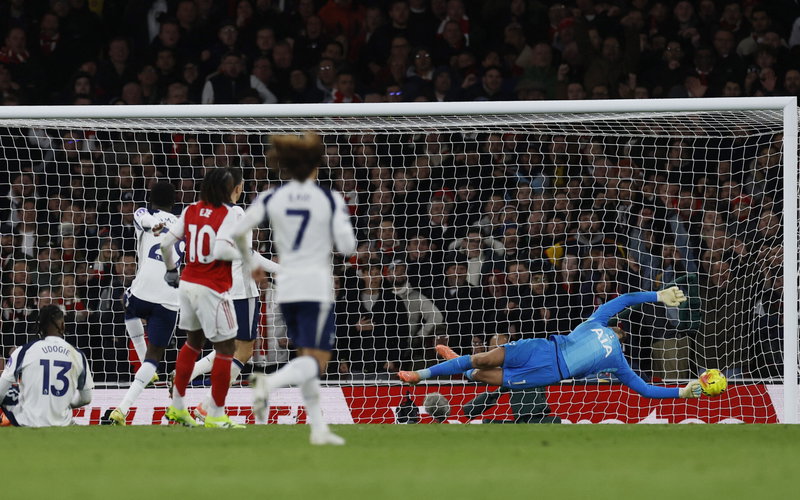
If Sunday’s North London Derby proved anything, it’s that the gap between Arsenal and Tottenham isn’t just a gap anymore it’s a chasm. The 4-1 demolition at the Emirates wasn’t just a win; it was a statement of intent, a tactical masterclass, and perhaps most insultingly for our neighbours, a victory achieved without Arsenal ever really needing to get out of third gear.
From the very first whistle, the tone was set. You asked for the team to be ready for battle? Mikel Arteta had them ready for a massacre.
The match had been billed as a clash of styles, but in reality, it was a clash of eras. One team is operating at the peak of European football, six points clear at the top of the Premier League; the other is still searching for an identity, trapped in a cycle of “transitions.” Yesterday, that reality was laid bare on the Emirates turf for the world to see.
The “20-Second” precedent: suffocation by design
The tone was set immediately. Straight from kick-off, the intensity was suffocating. While Spurs arrived with a negative 5-4-1 formation hoping to “disrupt and delay,” Arsenal’s intent was clear immediately.
Declan Rice’s volley inside the first three minutes was the warning shot, but the psychological blow was landed seconds after the first whistle. Arsenal hunted in packs, turning possession over high up the pitch and pinning Tottenham into their own box. It wasn’t frantic; it was calculated strangulation. We didn’t just win the ball; we owned the space.
No Gabriel? Enter Piero Hincapié.

Leading up to the game, the media narrative was dominated by one name: Gabriel Magalhães. The Brazilian’s absence due to injury was painted as a catastrophic blow, the “Achilles heel” that Tottenham’s attackers would ruthlessly exploit. Pundits spent all week theorising how Spurs would target the left side of Arsenal’s defence and dominate aerial duels.
Instead, the silence regarding his absence after the final whistle was deafening.
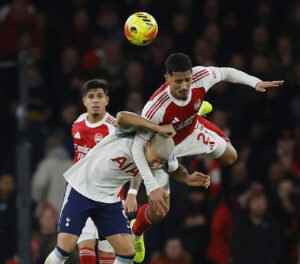
Piero Hincapié stepped into the breach and produced a performance of such aggression and class that he looked like he had been playing next to William Saliba for a decade. The Ecuadorian international didn’t just fill a gap; he imposed his will. His ability to drive out of defence with the ball broke Spurs’ first line of pressure repeatedly, and his recovery pace meant Spurs’ right-hand side didn’t get a sniff all afternoon.
Speaking on Sky Sports, Gary Neville highlighted this shift in Arsenal’s squad depth and psyche.
“The narrative going into today’s game, which I wasn’t even entertaining, was this: ‘Without Gabriel, they will struggle.’ No one is interested anymore. What they demonstrated today with Hincapié coming in so seamlessly is that they’ve moved beyond the period where they look for excuses. This is a team that simply says, ‘Next man up, do the job.’ It’s the mentality of champions.”
Fire and Ice: The Rice & Zubimendi axis
If the defence was the shield, the midfield was the sword. For the first time this season, we saw the true potential of the partnership between Declan Rice and Martin Zubimendi—a duo that is rapidly becoming the engine room’s answer to William Saliba and Gabriel Magalhães.
Just as our centre-back pairing balances aggression with composure, our midfield pivots have found their perfect yin and yang.
The Fireman: Declan Rice
Rice was the heartbeat of the operation. He played the role of the “fireman” to perfection. Wherever there was a spark of danger, he was there to extinguish it before it could become a flame. He is the physical force, the energy, the one who cleans up everything in his way like a powerful hose washing away debris. His recovery runs were monstrous, his tackling was crunching, and his drive from deep areas broke Tottenham’s lines at will. He makes the chaotic look routine.
The Architect: Martin Zubimendi
Beside the chaos of the fireman sits the elegance of the architect. Zubimendi was the picture of calm amidst the derby storm. While Rice destroyed, Zubimendi constructed. He doesn’t run the game with physicality; he runs it with his mind. Receiving the ball under pressure in the tightest of spaces, he never panicked. He simply pivoted, scanned, and progressed the ball with a surgeon’s precision.
Together, they form a relationship that is becoming the envy of Europe. One provides the steel, the other provides the silk. It is a partnership built on trust Rice knows he can hunt the ball because Zubimendi is holding the fort, and Zubimendi knows he can dictate the tempo because Rice will protect him. They dominated the middle of the park so completely that Tottenham’s midfield looked like they were playing a different sport.
Tactical genius: Breaking the 5-4-1 low block
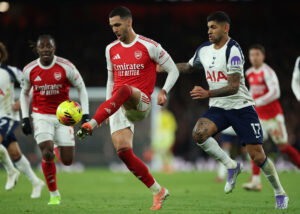
Mikel Arteta deserves immense credit for navigating what could have been a frustrating afternoon. Spurs came not to play, but to survive. In previous years, Arsenal might have panicked against such a rigid low block, forcing passes that weren’t there.
Yesterday, we simply passed them to death with patience.
The “Third Gear” narrative is backed up by the sheer control we had. We didn’t need end-to-end chaos. Instead, Arteta utilized Mikel Merino in that hybrid central role to occupy their centre-backs, creating pockets of space for the wingers. We controlled the tempo so completely that when the acceleration finally came, Spurs were frozen.
The “set-piece merchant” myth destroyed
For the last 18 months, a lazy critique has been levelled at Arteta’s side: “They rely too much on set-pieces.” Rival fans and pundits alike have tried to diminish Arsenal’s attack by claiming we lack fluidity in open play.
Yesterday, Arsenal scored four goals. Every single one of them came from open play.
There were no corners required to unlock this defence. No chaotic scrambles. Just pure, intricate, high-speed football. Jamie Carragher, who has been critical of Arsenal’s attacking aesthetics in the past, was forced to eat humble pie live on air.
“I’ve accused Mikel Arteta of being a bit ‘handbrake on’ at times,” Carragher admitted. “But today? Their open-play game was sensational. It’s what they’ve been accused of lacking, but looking at the intricate passing for Trossard’s goal and the fluidity of Eze’s movement… you can’t argue with that.”
The Ghost of 1978: Eberechi Eze ends the wait
While the tactical setup was the canvas, Eberechi Eze was the artist who painted the masterpiece.
For 47 years, a specific statistic has hung over this fixture like a spectre. Generations of Arsenal legends have come and gone—Ian Wright, Dennis Bergkamp, Thierry Henry—but none managed to take home the match ball in a league derby. You have to go back to December 23, 1978, to find the last Arsenal player to score a hat-trick in the North London Derby (Alan Sunderland).
Yesterday, Eberechi Eze didn’t just join that exclusive club; he kicked the door off its hinges.
In a performance of such casual brilliance that it felt less like a competitive sporting event and more like a coronation, Eze exorcised the ghost of ’78. Even Ian Wright, the man whose goalscoring records are etched in gold, could hardly contain himself, posting a video reaction simply laughing in disbelief at the audacity of Eze’s second goal. “He’s playing in the park!” Wrighty beamed. “He’s treating the North London Derby like a kick-about!”
Leo Trossard: The Reincarnation of Freddie Ljungberg
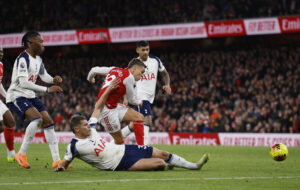
While Eze will rightly grab the headlines, the catalyst for this demolition was Leandro Trossard.
There is a growing feeling among the Arsenal faithful that Trossard is evolving into this generation’s Freddie Ljungberg. The comparison is becoming impossible to ignore. Just like the Swedish legend of the Invincibles era, Trossard doesn’t always need to dominate the ball to dominate the game.
The “ghosting” ability
Ljungberg made a career out of “ghosting” arriving late into the box, unseen. Trossard has mastered this dark art. His opening goal in the 36th minute was pure Ljungberg. As Merino engaged the physical battle, Trossard drifted off the blindside. He didn’t sprint; he glided. By the time the ball was played, he was already in the perfect position.
Efficiency over volume
Let’s look at the stats. In the 2001/02 title-winning season, Ljungberg was famous for his efficiency. Trossard is mirroring this output.
-
Trossard vs Spurs: 4 goals in his last 5 appearances.
-
Big game player: Like Freddie, Trossard scores when it matters. Liverpool, City, Porto, and now Spurs.
The demolition in numbers (Stats & Facts)
The “eye test” showed a thrashing, but the underlying data paints an even grimmer picture for Tottenham. This wasn’t a contest; it was a training exercise.
| Statistic | Arsenal | Tottenham |
| Total Shots | 17 | 3 |
| Shots on Target | 8 | 2 |
| Expected Goals (xG) | 1.88 | 0.07 |
| Possession | 57.4% | 42.6% |
| Open Play Goals | 4 | 1 |
| Passes Completed | 442 | 326 |
At halftime, Tottenham’s xG was literally 0.00. They did not create a single statistically significant chance in the first 45 minutes.
Spurs managed just two shots on target all game. One was a harmless header, and the other was Richarlison’s freak consolation goal in the 55th minute. We have to give credit where it’s due the 45-yard lob over David Raya was a stunning strike. But it was a “glitch” in the matrix. It didn’t come from sustained pressure; it was a moment of individual improvisation in a game where his team was otherwise comatose.
Anatomy of the hat-trick
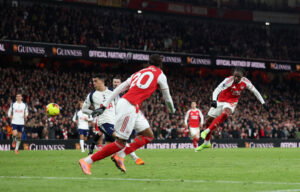
To fully appreciate the history, we must break down Eze’s three strikes.
-
The Dagger (41st Minute): After Trossard’s opener, Spurs were wobbling. Declan Rice won a duel in midfield and fed Eze. The finish was low, hard, and decisive. 2-0.
-
The “kick-off glitch” (46th Minute): The second half was 36 seconds old. Timber drove forward, Spurs backed off, and Eze caressed a left-footed shot into the bottom corner. It was 3-0 before some fans had even returned to their seats.
-
The coronation (76th Minute): The pick of the bunch. Receiving the ball from Trossard, Eze stood still for a split second—a “pause” that froze three Tottenham defenders. In that pause, he saw the picture. He shifted the ball and curled a majestic effort into the far corner.
Conclusion: A fortress restored
We did it without our best defender. We did it without needing a single corner kick. We did it in third gear.
As the fans spilled out onto the Hornsey Road, the chants were singular. “Eze, Eze, Eze.” The history books will say it was just three points. But those of us who were there know the truth. It was the day Eberechi Eze announced himself as the King of North London, and the day Arsenal proved they don’t need excuses they just need a football.