

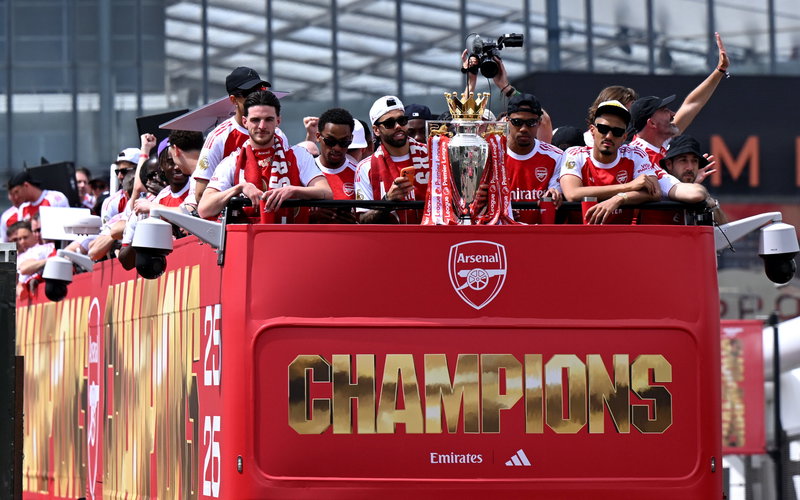
The Metropolitan Police had predicted it, the packed trains steaming into King’s Cross from every corner of the country bore it out, and by Sunday evening, Islington Council officially confirmed it: more than one million people had flooded the five-mile stretch of North London. Early estimates had cautiously pegged the turnout at 750,000, but as the red smoke cleared and the sheer scale of the cleanup operation became apparent—with Arsenal rightly footing the bill for a historic operation—the true magnitude of the day was undeniable. This was the largest sporting parade in English history.
Yet, numbers alone fail to capture what actually transpired between Finsbury Park and the steps of the Emirates Stadium. To view Sunday simply as a celebration of a men’s Premier League title—the club’s first in twenty-two long years—is to miss the entire point of the modern Arsenal identity.
Less than twenty-four hours earlier, thousands of these same supporters had been left in tears in Budapest, watching the men’s team suffer a heartbreaking penalty shootout defeat to Paris Saint-Germain in the Champions League final. By 9:00 AM the following morning, the squad was departing their Hilton hotel in the Hungarian capital, weary and bruised. In any other era, or at any other club, such a devastating continental blow might have cast a somber pall over domestic celebrations. Instead, North London responded with an unprecedented wall of unconditional love.
When the open-top buses turned off Blackstock Road towards Newington Green, they were met by a heaving, roaring sea of humanity. This was not a crowd seeking perfection; it was a community celebrating a profound, hard-won resurrection. It was an event that transcended the boundaries of the men’s first team, serving as a dual coronation and a heartfelt gratitude journal for a football club that has fundamentally repaired its relationship with its people.
The vignettes of Highbury and Holloway
To walk the route on Sunday was to witness a borough completely transformed, where the ratio of Arsenal shirts to ordinary clothing was a staggering two to one. Every square inch of Islington’s urban architecture was claimed by the collective joy of the fanbase.
-
The lookouts: On Holloway Road, a daring contingent of supporters established a vantage point on top of the Tesco Extra roof.
-
The neighborhood: Along the backstreets of Highbury, residents who hadn’t left their homes all morning sat out on their front stoops or perched precariously on first-floor roofs in foldable chairs, passing down drinks to strangers below.
-
The details: Flags fluttered from every Victorian window, a solitary Gunnersaurus towel was hung proudly like a royal tapestry over a balcony, and in one of the day’s most beautifully absurd sights, a middle-aged man was spotted hobbling down the road in full, immaculate match kit—including football boots clacking against the tarmac.
When the players finally came past, the collective reflex was instantaneous. Thousands of phones were thrust into the air, zooms were pinched, and the fleeting, red-tinted moment was captured forever. Then, just as quickly, the crowd would disperse, darting down side streets to catch the procession at its next odyssey point, or simply returning to spontaneous street picnics that had broken out on traffic islands.
This was a carnival without borders. It belonged to the local residents who tolerate the weekly chaos of match days, and it belonged to the global fans who had travelled across oceans just to stand outside a North London pub and breathe in the atmosphere.
Vindicated: The reclamation of the ‘Banter Era’ generation
If this historic parade belonged to any specific demographic, it was undeniably to those under the age of thirty. The streets were an absolute sea of youth, many of them ironically sporting the iconic O2-sponsored shirts of Arsène Wenger’s 2003/04 Invincibles—a legendary team that most of these young adults are legally too young to actually remember.
For this generation of Gooners, football has not been an easy ride. They are the children of the “banter era,” a hyper-cynical epoch of modern football history where Arsenal became the internet’s favourite punchline. They grew up during the years of repetitive top-four finishes, heavy continental defeats, a fractured Emirates stadium atmosphere, and the toxic, amplified negativity of early social media fan channels.
THE DUALITY OF THE GENERATION

|  The Football Tribulations         |  The Real-World Context          |
|  • Peak 'Banter Era' mockery       |  • The 2008 Financial Crash      |
|  • Ticket prices out-pricing youth |  • The Isolation of COVID-19     |
|  • Toxic social media landscapes   |  • An ongoing cost-of-living crisis|
To be a young Arsenal fan for the past fifteen years was to endure endless mockery. Compounding this was the reality of the hyper-commercialised modern game, where a day out at football can easily cost a young person a week’s wages, effectively pricing out the very demographic that provides a club with its soul. Beyond football, this under-thirty group has lived through a global financial crash, the profound isolation of Covid-19 lock downs, and a relentless socio-economic squeeze.
Therefore, Sunday was far more than an athletic celebration; it was a release valve for two decades of pent-up frustration. It was a declaration that the identity forged in adversity had survived. When Declan Rice took the microphone during the parade, his words directly mirrored the fierce loyalty of the youth looking up at him:
“I love this team. I love this manager. To see the joy we can give people is crazy. Next year, we’re coming back for more.”
Rice’s defiance completely erased the sting of the Budapest defeat. The fans weren’t mourning a lost Champions League final; they were celebrating the fact that they finally had an elite, modern football team that loved them back.
A shared canopy: World champions in the Islington sun
Crucially, the narrative of Sunday’s parade was not monopolised by the men’s domestic success. In a beautiful, deliberate reflection of the club’s egalitarian ethos, the parade served as a vital platform to celebrate the monumental global achievements of Arsenal Women.
Under the masterful guidance of Renée Slegers, the side added further silverware to the cabinet with another domestic cup competition triumph this season. Yet, the true seismic milestone riding atop the bus was their coronation on the world stage. Having conquered Europe last term, Arsenal Women went on to win the inaugural FIFA Women’s Champions Cup earlier this year—defeating South American champions Corinthians in a thrilling extra-time final right here at the Emirates Stadium to become the very first winners of the global competition.
                  ARSENAL WOMEN: THE BEDROCKS OF THE CLUB

 Player            Years of Service    Legacy & Impact
  Katie McCabe      11 Years            The fiery, versatile engine
  Beth Mead         9 Years             The resilient, iconic finisher
The sight of both squads sharing the limelight on the streets of Islington was a testament to the fact that at Arsenal, football is a singular, unified ecosystem. For the regular attendees of Meadow Park and the roaring crowds at the Emirates, the parade provided a deeply emotional opportunity to say a massive, public thank you to two players who have quite literally carried the torch for Arsenal Women through its modern evolution: Katie McCabe and Beth Mead.
The vanguard of the Women’s game
McCabe, who has now given an incredible eleven years of tireless, fiery service to the badge, and Mead, who has stood as a creative and goalscoring focal point for a brilliant nine years, received ovations that rivalled any given to the men’s squad. These two women have experienced the full spectrum of the sport’s rapid growth. They played for Arsenal when women’s football fought desperately for basic media coverage; they tore their ACLs, won trophies, suffered heartbreak, and ultimately helped build a product that can now comfortably command the global stage.
Seeing Mead and McCabe atop that bus, world champion medals catching the North London sun, was a poignant reminder of loyalty in an era defined by transient transfer portal movements. They represent the bridge between the pioneering days of the women’s game and its current status as a cultural juggernaut. The roaring crowds ensured that their contributions were woven directly into the fabric of the club’s greatest historical day.
The social fabric of North London
Ultimately, when the final plastic cups are swept up from the pavement and the traffic resumes its normal crawl down the Holloway Road, the true legacy of the one-million-strong parade will not be found in the statistics or the trophy cabinets. It will be found in the intangible rebuilding of a community.
For twenty-two years, Arsenal fans dreamed of this parade, often visualising it through a lens of relief or arrogant vindication. But the reality was entirely different. It was a day marked by profound gratitude, inclusivity, and shared identity. It proved that a football club can lose a Champions League final on a Saturday night and still host the happiest party on earth on a Sunday morning, because the bond between the players and the streets has been permanently restored.
Arsenal have conquered England once again, but more importantly, they have successfully reclaimed the soul of North London.