

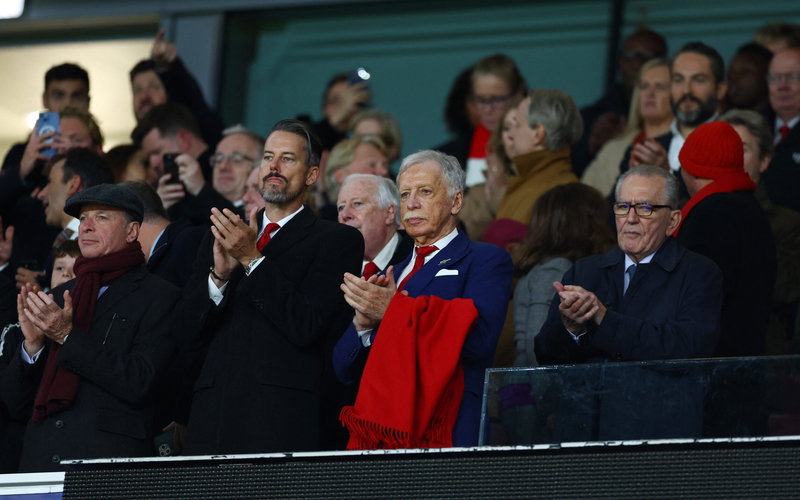
In a development that has sent ripples of surprise and speculation through the football world, Tim Lewis, a man widely regarded as one of the key architects of Arsenal’s recent resurgence, has stepped down from his role as executive vice-chair. His departure is far more than a simple reshuffling of the boardroom; it signals a significant shift in the club’s power structure and concludes an era defined by quiet, behind-the-scenes influence and a deep-seated connection to the Kroenke ownership.
The Historical Context: From Public Company to Private Control
To understand Tim Lewis’s importance, one must first appreciate Arsenal’s unique history. For decades, the club operated as a public limited company, with shares traded on a specialist market. This structure, while providing a degree of transparency, was seen by many as a financial constraint that prevented the club from competing with the “sugar daddy” owners of rivals.
Lewis first entered this complex picture in 2007 as a corporate lawyer, advising Stan Kroenke during the American billionaire’s initial acquisition of a stake in the club. His role evolved from legal consultancy to a more central, strategic position. He was instrumental as Kroenke gradually increased his shareholding, ultimately taking full control in 2018 and de-listing the club from the stock market. It was in this new, private landscape that Lewis’s influence truly soared.
The Pillar of Stability: An Architect of Modern Arsenal
Lewis was not just a board member; he was the operational architect who built the financial and political foundations for the club’s current success.
- Financial Restructuring: During the turbulent period of the COVID-19 pandemic, when revenues plummeted, Lewis spearheaded the refinancing of the club’s debt. He oversaw the process of refinancing the stadium’s bank debt with new debt from the parent company, Kroenke Sports and Entertainment (KSE). This was a crucial move that stabilised Arsenal’s financial position, freeing up millions in cash reserves that were previously mandated by bank loans. While this provided immediate financial flexibility, it also shifted the debt to the owner, a point of contention for some who view it as a “payday loan” scenario.
- A Bridge to the Manager: Lewis became a crucial link between the distant Kroenke ownership and the footballing leadership in London. In the “All or Nothing” documentary, he articulated his role clearly: “My role is not to give football advice but to be there to support and challenge.” He was a key backer of Mikel Arteta, providing the manager with the counsel and confidence needed to build a long-term project. This trust was a fundamental reason why Arteta’s contract was extended in 2022, even after a disappointing end to the season.
- Influence on Transfers and Policy: Lewis was the final financial gatekeeper on major transfer deals. His influence was keenly felt in the £250 million summer transfer window, one of the most proactive in the club’s history. His direct involvement, leveraging years of established professional relationships—such as his rapport with Crystal Palace chairman Steve Parish in the £67.5 million signing of Eberechi Eze—ensured key deals were completed. Beyond transfers, Lewis was a respected voice in Premier League meetings, where he advocated for Financial Fair Play and campaigned against takeovers by nation-states.
The Heart of a Fan: A Personal Journey
Beyond the corporate titles and boardroom discussions, a significant part of Tim Lewis’s story at Arsenal is that he was a lifelong fan of the club. His love for the Gunners wasn’t just a detail; it was a driving force behind his dedication and a source of deep personal meaning.
For a supporter, the opportunity to work at the highest echelons of your beloved club is the ultimate dream. Lewis got to live that dream, but in a capacity that required immense responsibility and a cool head. He didn’t just advise a client; he was helping to steward the club he had supported for a lifetime. When his appointment as a director was first announced in 2020, he encapsulated this sentiment perfectly, stating: “I am looking forward to the opportunity to work with Stan, Josh, the board and executive team to help take the club forward at this critical time.” This quote reveals not just a professional ambition, but the genuine excitement of a fan ready to serve.
This personal connection added an unspoken layer of passion to his work. While he maintained a professional distance, his love for the club ensured that every financial decision and every strategic move was made with the best interests of Arsenal at heart. He was an insider who also saw the club through the eyes of a supporter, a unique position that few people ever get to experience. The fact that he was able to play such a significant role in a period of “transformational change” for a club so close to his heart makes his sudden departure even more poignant.
Analysis: A New Power Structure and the Implications
The sudden departure of Tim Lewis has been described by some in the media as a “seismic” and “shock” event, coming at a time when the club appeared to be at its most stable. His exit suggests that this was not a matter of under performance, but rather a deliberate and strategic move by the club’s ownership to usher in a new era.
The official stance from the club is that this is an “evolution,” not a crisis. This is a very telling detail, as it signals a significant shift in the club’s leadership dynamic. Lewis was Stan Kroenke’s most trusted adviser, but it appears the club is now transitioning to an era where Josh Kroenke, Stan’s son, will take on a more direct and hands-on role.
This is where Richard Garlick enters the picture in a major way. A qualified sports lawyer and former Premier League Director of Football, Garlick joined Arsenal in 2021 as Director of Football Operations. He was promoted to Managing Director in 2024 and has now been elevated to the role of Chief Executive Officer. His promotion fills a position that has been vacant since the departure of Vinai Venkatesham and makes him the public face of the club’s administration. He is widely seen as a more measured figure compared to Lewis’s direct and sometimes forthright approach. Garlick’s promotion and the appointment of new non-executive directors—including KSE’s Kelly Blaha (senior VP of sports finance), Otto Maly (a real estate specialist), and film producer Ben Winston—signal a deliberate desire to bring the ownership family and their trusted advisers closer to the club’s operations.
Public Perception and Legacy
The reaction to Lewis’s departure from both fans and pundits has been a mix of surprise and speculation. On one hand, many fans expressed shock, given his long-standing and pivotal role in the club’s recent success. On the other hand, the move has been largely framed as a natural, if sudden, “changing of the guard,” with some suggesting Lewis was brought in to “fix” a situation and is now moving on to the next challenge. Mikel Arteta’s poignant comments on the matter underscore the personal impact of his exit, stating, “I’ve been very lucky to work with some wonderful people… It’s sad… you get really attached to them emotionally as well.”
Ultimately, Tim Lewis leaves a legacy of stability and strategic vision. He was the unheralded architect who built the financial and political foundations that allowed the club to move forward and compete at the highest level. His departure means Arsenal has lost an experienced, influential, and deeply loyal figure. While the club insists that the future is bright, the new leadership team, headed by Josh Kroenke and now with Richard Garlick as CEO, will face the challenge of maintaining the momentum and stability that Lewis helped to build. The coming years will be a test of whether a more direct and collective leadership can match the singular, trusted guidance of the man who served as a vital bridge between Arsenal’s past and its promising present.