

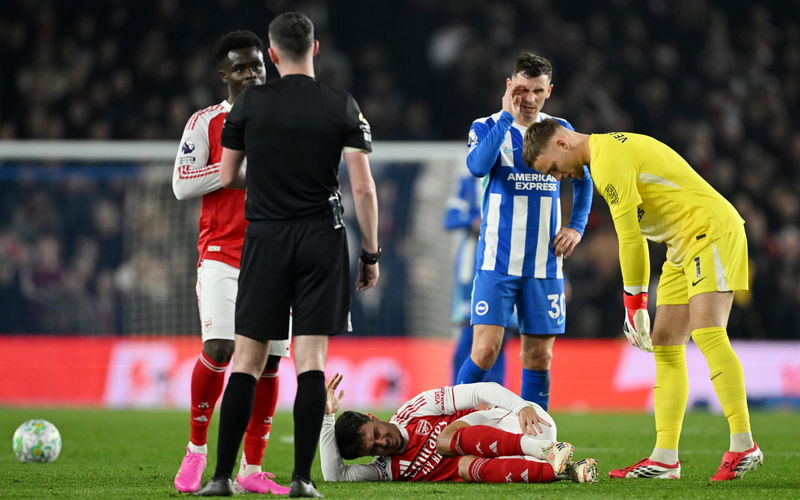
The date is March 5th 2026. Arsenal sit seven points clear at the summit of the Premier League after a gruelling 1-0 victory away at Brighton. For any other team, this would be heralded as the “mark of champions”—the ability to travel to a difficult ground on a midweek night, withstand a coastal gale, and grind out a result. Instead, the airwaves are thick with a different, more cynical narrative. From Alan Pardew’s suggestions of “asterisks” to Fabian Hürzeler’s accusations of “anti-football,” a culture war has erupted over the soul of the North London club.
The central question haunting the British sports media is this: Why is Mikel Arteta being judged by a standard of aesthetic purity that was never asked of Jose Mourinho, Sir Alex Ferguson, or even the Leicester City “fairy tale” of 2016?
I. The “Asterisk” Narrative: Aesthetics as a Weapon
The most explosive contribution to the current discourse came from former manager Alan Pardew, who characterised Arsenal’s rise not as a tactical masterclass, but as a “functional display” devoid of beauty. Pardew’s claim—that a title win for this Arsenal side should carry an asterisk—suggests that in the modern era, winning is no longer the sole metric of success; one must win “the right way” to be deemed legitimate.
As Laura Woods passionately argued on talkSPORT, this is perhaps the most disrespectful charge a professional can level at a league leader. The irony is palpable. For a decade, the media consensus on Arsenal was that they were “soft,” “too pretty,” and possessed a “lightweight belly.” The common refrain from pundits like Roy Keane and Gary Neville was that Arsenal lacked the “nastiness” to win a league. Now that Arteta has hardened that belly and introduced a streak of streetwise pragmatism, the goalposts have been moved. The “tippy-tappy” football that saw Arsenal finish outside the top four is suddenly the gold standard they are “failing” to meet, while the grit that actually wins trophies is labelled “boring” or even “cheating.”
II. The Hürzeler-Arteta Clash: Gamesmanship or Grit?
The fallout from the Brighton match centred on the conduct of David Raya and Arsenal’s sophisticated game management. Fabian Hürzeler’s post-match press conference was a study in ideological frustration. He claimed there was “only one team who tried to play football” and took aim at Raya for going down three times to break Brighton’s momentum.
“I will never be that kind of manager who tries to win in that way,” Hürzeler remarked. “I want to develop players… what are the supporters paying for?”
Arteta’s response was a masterclass in brevity: “Really?” He chose not to engage in a philosophical debate, instead validating his players’ competitive spirit. Simon Jordan correctly identified the flaw in Hürzeler’s logic: if you are the “better” footballing side, it is your responsibility to find a way through. To blame an opponent’s time-management for your own inability to score is a deflection of managerial failure.
The media narrative surrounding “time-wasting” has become a tool to delegitimise Arsenal’s defensive solidity. When Mourinho’s Chelsea “parked the bus” at Anfield in 2014, it was called “tactical discipline.” When Arteta’s Arsenal shuts down a game at the Amex, it is called a “disgrace.” This disparity suggests a deep-seated discomfort with the idea of Arsenal as a physically imposing, defensive juggernaut.
III. The “Boring” Tag and the Global Narrative
Adding fuel to the fire is the reported sentiment from Liverpool’s Arne Slot, who allegedly described the current brand of Premier League football as “boring.” This sentiment echoes a wider trend where high-possession, low-risk football is being scrutinised for its lack of “chaos.”
However, the “boring” tag is rarely applied to managers who are currently in the “honeymoon” phase of their tenure. When Ruben Amorim arrived at Manchester United, or Slot at Anfield, the narrative was centred on “stability” and “foundations.” They were given a license to be efficient. Arteta, however, is being denied this license.
There is a persistent demand that Arsenal must be the heirs to Arsène Wenger’s 2004 “Invincibles,” even if that style is no longer the most effective way to beat a low block in 2026. This creates a “style tax” that only Arsenal seems to pay. If they win 4-0, it’s expected; if they win 1-0, it’s a scandal.
IV. The Disparity of Political Capital: Arteta vs. The World
To understand why the media is so hostile toward Arteta’s pragmatism, we must look at the “time and patience” disparity. Arteta is currently in his seventh year. He was afforded the political capital to survive two eighth-place finishes—a luxury that would never be granted to a manager like Ruben Amorim or even a modern-day Chelsea boss.
Because the Arsenal board (and the fans) “Trusted the Process” through the dark days of 2020 and 2021, the media feels a sense of entitlement to a specific “return on investment.” They view the current Arsenal side as a project that was funded by unprecedented patience, and they are offended that the final product is a defensive machine rather than a flamboyant circus.
Contrast this with the treatment of other managers. When a manager like Amorim reaches 50 games, he is judged on the immediate “vibe” and results. Arteta is judged against the ghost of Arsenal’s past and the cost of his own longevity. The media narrative is: “We waited five years for this?” to which the league table answers: “Yes, seven points clear.”
V. The Set-Piece Revolution: Innovation or Infraction?
A core pillar of the “ugly” narrative is Arsenal’s dominance in set-piece situations. Under Nicolas Jover, Arsenal have turned corners and free kicks into a primary scoring weapon. Pundits have begun to use this as a stick to beat them with, suggesting that scoring from a corner is “lesser” than scoring from open play.
This is a bizarre tactical snobbery. In any other sport—take the NBA or NFL—maximising “special teams” or “out-of-bounds plays” is considered genius. In the Premier League, if Arsenal use Ben White to subtly impede a goalkeeper, it’s treated as a moral failing. This hyper-scrutiny of Arsenal’s set-piece routines is a direct result of the media’s inability to find flaws in their open-play defence. If you can’t beat them on the pitch, you criticise the way they stand in the box.
VI. The “Siege Mentality” and the Road to May
The “culture war” surrounding Arsenal has inadvertently handed Mikel Arteta his greatest weapon: a siege mentality. By suggesting that an Arsenal title win would be “tainted” or “functional,” the media has unified the Arsenal dressing room and the Emirates crowd.
Simon Jordan noted that the media is seeding a narrative of bias that will become “orthodoxy” by the end of the season. If Arsenal hoist the trophy in May, the retrospective will likely focus on the “death of beautiful football.” But for the fans who sat through the 5-0 drubbing at City in 2021 or the collapse at Newcastle in 2022, “beautiful” is a distant second to “first.”
VII. Conclusion: The New Arsenal Identity
The “asterisk” talk is the ultimate compliment. You do not try to delegitimise a team that is finishing fourth. You only attempt to rewrite the rules of “greatness” when a team has become so efficient that you can no longer find a way to stop them on the grass.
Mikel Arteta has successfully transitioned Arsenal from a “project” into a “machine.” Machines are not designed to be pretty; they are designed to perform a function with 100% reliability. The function of this Arsenal team is to win the Premier League. If the cost of that trophy is a few complaints from a frustrated Brighton manager and a bitter quote from Alan Pardew, it is a price every Arsenal fan will pay with a smile.
The “Process” wasn’t just about moving players out; it was about moving a mindset in. Arsenal are no longer the league’s “favourite second team” or the “neutral’s choice.” They are the “boring,” “ugly,” seven-point-clear leaders. And that is exactly what a champion looks like.