

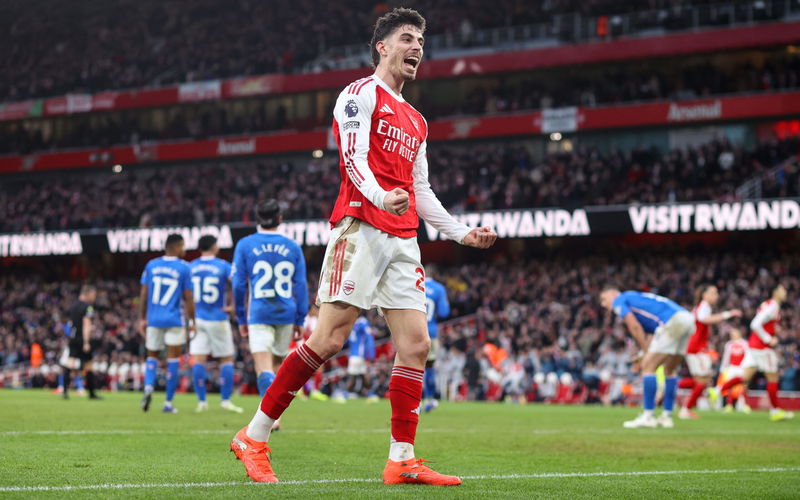
I. The sixty-second snapshot
If you wanted a snapshot of the Kai Havertz experience in February 2026, you didn’t need a ninety-minute tactical cam; you just needed the opening sixty seconds against Sunderland at the Emirates.
The whistle blows. Within forty seconds, Havertz has ghosted into the “corridor of uncertainty,” meeting a fizzed Leandro Trossard cross. He misses. It’s a header he should score, the kind that sends the “Expected Goals” (xG) merchants into a frenzy on social media. But watch the next thirty seconds. As Sunderland break, it is Havertz—having sprinted sixty yards back—who makes a goal-line block to deny Brian Brobbey and bail out David Raya.
It was messy. It was selfless. It was quintessential Kai.
As Arsenal sit nine points clear at the top of the Premier League table following a clinical 3-0 win, the conversation around the German international has evolved. We have moved past the “is he worth £65m?” debate of 2023. In 2026, we are debating whether Havertz is the most misunderstood genius in Premier League history or simply the ultimate “Arteta Player”—a man built in a lab to satisfy one manager’s obsession with “total control.”
II. The return of the “tactical glue”
The dismantling of the Black Cats wasn’t just another three points; it was a testament to the “connective tissue” Havertz provides. Coming off a gruelling injury layoff that saw him sidelined for the tail end of 2025, Havertz has returned like a man possessed.
Mikel Arteta’s post-match comments after the Sunderland victory were telling. While the media focused on Viktor Gyökeres’ brace, Arteta was focused on his number 29:
“We are really happy to have him. He offers something very different to the team… to show the level he’s shown immediately after such a long injury is very impressive. He understands the spaces better than anyone I’ve ever coached.”
Against Sunderland, Havertz’s heat map looked like a Jackson Pollock painting. Starting as a “Left 8,” he spent 40% of his time in the central striker zone, allowing Gyökeres to drift wide and terrorise the full-backs. When Havertz occupies a centre-back, he isn’t just standing there; he’s pinning them, manipulating the defensive line, and creating the pockets that Martin Ødegaard (who missed the game with a knock) usually exploits. It’s an invisible contribution, but without it, the Arsenal machine grinds to a halt.
Tactical breakdown: Havertz vs. Sunderland (Feb 7, 2026)
Match Rating: 7.9 (FotMob/WhoScored)
Defensive Interventions: 1 Goal-line block (1st minute), 4 Clearances, 2 Tackles won.
Offensive Impact: 1 Assist (for Gyökeres’ first goal), 3 Chances created.
The “Invisible” Stat: Havertz covered 11.8km—the most of any Arsenal player on the pitch. His “pressure regains” in the middle third directly led to the sequence for Martin Zubimendi’s opener.
Aerial Dominance: Won 6 out of 10 aerial duels, providing the long-ball outlet when Sunderland attempted to press high.
III. Deep dive: The Chelsea semi-final & the badge
While the Sunderland game was a display of control, the Carabao Cup semi-final second leg against Chelsea on February 3rd was a display of pure, unadulterated clutch.
The tension at the Emirates was suffocating. Having drawn the first leg, Arsenal were four semi-final defeats deep under Arteta. The “bottle” narrative was sharpening its knives. Enter Havertz in the 97th minute. On a rain-soaked night, Declan Rice carried the ball forward on a breakaway, sliding it to Havertz.
The composure was startling. In a moment where most strikers would have lashed at the ball, Kai rounded Robert Sanchez with the nonchalance of a man taking a Sunday stroll, before tapping into an empty net to seal the aggregate win. His celebration—a pointed tap of the Arsenal badge in front of the travelling Chelsea support—was the final bridge burned. He isn’t just a Chelsea legacy; he is an Arsenal hero who has now scored against his former club in three separate competitions.
IV. The “Dune Messiah” and the online civil war
The media narrative surrounding Havertz has taken a surreal turn. On social media, he has been ironically (and then unironically) dubbed the “Dune Messiah.”
Why? Because his impact is often described in almost mystical terms by those who defend him. To his supporters, he is Paul Atreides—a figure who sees the “Golden Path” of the play before it happens. To his detractors, he’s a player who “does a lot of running” but lacks a clinical edge.
Community Voices from the Arsenal Mania Boards:
-
NorthLondonSoul: “He’s not Haaland, but Havertz is so much better than any rival fan gives him credit for. He makes difficult things look simple. If you don’t see what he brings, you aren’t looking at the whole pitch.”
-
KingKai29: “People moan about his wages, but you can’t buy tactical intelligence like this for cheap. He’s the only player who can play three positions in one game without the system breaking.”
-
HighburyGhost: “The ‘Dune Messiah’ thing is funny, but there’s truth to it. He operates on a different frequency. You don’t realize how much you miss him until he’s on the treatment table.”
V. Historical context: The “Firmino-fixation” of Kai
To understand Havertz, you have to look at the history of the “Unconventional Forward.” Fans often fall into what some call “Firmino-brain”—the idea that a striker’s primary job is to help everyone else score.
-
Roberto Firmino: Dropped deep to allow Salah and Mané to act as the primary scorers.
-
Thomas Müller: The Raumdeuter (Space Investigator). He doesn’t have a fixed position; he simply finds the space where the opponent is weakest.
-
Kai Havertz: He is a fusion of both. Like Firmino, he is a pressing monster. Like Müller, his timing in the box is elite. However, Havertz brings a physical profile (6’4″) that neither of those possessed. He is Arsenal’s “get out of jail free” card—when the press is too high, Raya can simply clip a ball to Kai’s chest, and the transition begins.
VI. The Ethan Nwaneri pathway
One of the most overlooked benefits of the “Havertz Era” is what it does for the academy. At 18, Ethan Nwaneri is the crown jewel of Hale End. With Mikel Merino out for months with a rare foot injury and Trossard picking up a hamstring knock against Sunderland, the calls for Nwaneri to start every game are deafening.
However, by having a veteran like Havertz—who was himself a “teen prodigy” at Bayer Leverkusen—Arteta can shield Nwaneri. Havertz takes the physical battering from Premier League centre-backs, allowing Nwaneri to come on in the final 20 minutes and express himself in a settled environment. Havertz isn’t just a player; he is a structural shield for the next generation.
VII. The “Wife Metaphor” and the human element
We cannot talk about Havertz without mentioning his relationship with Mikel Arteta. Back in 2023, Arteta famously compared his pursuit of Havertz to “conquering his wife”—a long, difficult process that required persistence and belief.
In 2026, that marriage is in its honeymoon phase. Havertz recently stated that Arteta gives “tasks down to the last detail.” This psychological safety is why we see Havertz tracking back in the 90th minute. He isn’t playing for his stats; he is playing for his manager.
VIII. The Bayern Munich shadow & contract talks
Nothing validates a player’s worth quite like the envy of European giants. This week, reports have intensified that Bayern Munich, under Vincent Kompany, have identified Havertz as the “star signing” needed to partner Harry Kane.
Arsenal’s response has been swift: opening talks for a contract extension until 2030. In the hyper-inflated market of 2026, where players like Viktor Gyökeres command £100m+ valuations, Havertz’s “versatility value” is immeasurable. You don’t rush to the negotiating table for a “flop.” You do it for the man who makes the entire system viable.
IX. Statistical reality: The “Havertz effect”
-
The Win Rate: Since January 2026, Arsenal have won 100% of the games Havertz has started.
-
Defensive Work: He leads all Premier League forwards in “defensive actions per 90” (3.4).
-
The Zubimendi Link: Since Martin Zubimendi joined the midfield, his pass completion rate to Havertz is a staggering 92%. Kai is always the “available” man.
X. Conclusion: The ultimate Arteta player
Mikel Arteta’s “Process” was never just about buying the best players; it was about buying the right players.
Kai Havertz is the living embodiment of the Arteta era. He is disciplined, versatile, humble, and tactically obsessed. He is a player who would rather make a recovery run to save a goal than hang on the shoulder of the last defender to stat-pad.
As we approach the final stretch of the 2025/26 season, with a nine-point lead to protect and a Carabao Cup Final at Wembley, the debate will likely continue. But as the “Dune Messiah” memes suggest, perhaps Kai Havertz is simply operating on a level that the rest of us are still trying to understand.
If Arsenal lift the Premier League trophy in May, we won’t be talking about his xG. We’ll be talking about the glue that held the greatest Arsenal team in twenty years together.
Long live King Kai.
One thing that stands out in discussions about creative midfield roles in modern football is how certain players bring balance and control that goes beyond stats alone. Orkun Kökçü has shown that kind of tactical intelligence — his movement, ability to link play between defense and attack, and vision in tight spaces make him exactly the type of midfielder a team looking for “invisible impact” would value. If you want a closer look at what kind of qualities he offers and how they fit into a manager’s tactical plans, this profile is a great read:
https://www.eaglemedia.com.tr/kimdir/tanitim/orkun-kokcu/65391