

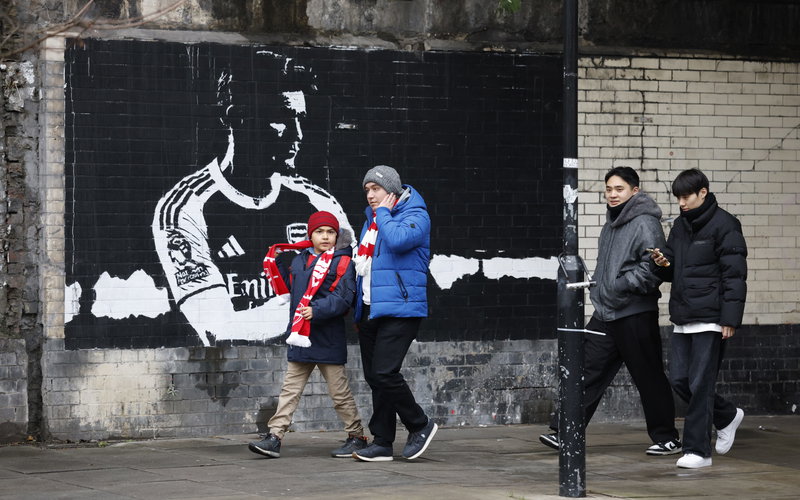
There is a specific kind of silence that only exists at the Emirates Stadium. It isn’t the silence of apathy; it’s the heavy, suffocating “hushed expectant” silence of sixty thousand people holding their collective breath. After a January that saw a seven-point lead shrink to four following a bruising 3-2 defeat to Manchester United, that silence has returned, bringing with it the “scar tissue” of decades spent as the “nearly men.”
But as the pressure rises, the media vultures have found a new target. No longer content with questioning the “Process,” they have turned their sights on the man wearing the armband.
I. The Scholes narrative: scapegoating the captain
In the modern football media landscape, “analysis” often boils down to finding a high-profile scapegoat for a 0-0 draw. Recently, Paul Scholes—appearing on the Stick to Football podcast—sharpened his tools and pointed them directly at Martin Ødegaard. Scholes’s thesis was as blunt as a studs-up challenge: Ødegaard is “the problem” because his tendency to drop deep to collect the ball is leaving Arsenal’s front line isolated and toothless.
Scholes argued that by playing “where Roy Keane should be,” Ødegaard is abandoning his post as a No. 10. On the surface, the narrative carries weight. In the recent stalemates at Anfield and the City Ground, there were long stretches where our £100m striker, Viktor Gyökeres, looked like a man stranded on a deserted island. But to blame Ødegaard’s positioning is to look at the symptom rather than the disease.
II. The “Donkey Work” Data: A victim of the system?
The reality is that Martin Ødegaard is currently being forced into a role that is part-architect, part-labourer. In the 2025/26 season, statistics show that Ødegaard is covering more ground than almost any other creative player in Europe—averaging a staggering 12.18km per 90 minutes.
Why is our primary creative engine running himself into the ground in our own half? The answer lies in a tactical bottleneck. With the transition from defence to attack becoming slower and more predictable in 2026, the ball is frequently getting stuck in the “Zubimendi-Rice” pivot. When the lanes to the wingers are blocked, Ødegaard feels a tactical obligation to drop 20 yards deeper than he did in 2024 to “jump-start” the engine.
We aren’t seeing a “lazy” or “ineffective” player; we are seeing a player doing the “donkey work” for a midfield that has, at times, played with the handbrake on.
III. The isolation effect: The Saka and Gyökeres factor
Scholes is right about the result—isolation—but fundamentally wrong about the intent. When Ødegaard is forced to drop deep to bypass a mid-block, the “Right-Sided Triangle” that once devastated the league (White, Saka, Ødegaard) collapses.
-
The Saka Shadow: Without Ødegaard occupying the half-space to pull defenders away, Bukayo Saka is frequently double-teamed.
-
The Isolated Nine: Gyökeres, who thrives on quick verticality, is instead forced to wait for a slow, 15-pass buildup that allows opposition defences to set their block.
The media calls it a “lack of ambition.” In reality, it is a captain trying to fix a broken structural transition through sheer physical output.
IV. The punditry of jealousy: O’Hara and the haters
While Scholes offers tactical critiques (however misguided), the likes of Jamie O’Hara represent the lower tier of the pressure cooker: pure, tribal jealousy. O’Hara’s constant rants about Arsenal “bottling it” or Ødegaard being “overrated” are the hallmarks of a man whose own club is currently light-years behind the standards set at London Colney.
Let’s be honest: O’Hara wasn’t good enough to wear the shirt, so now he tries to tear it down from a studio microphone. His “hatred” isn’t based on what’s happening on the pitch; it’s based on the terrifying reality for Spurs fans that this Arsenal project—led by Ødegaard—is still top of the league despite the “wobble.”
V. The expectation gap: fans vs. players
This “nervousness” that has permeated the last three games is a two-way street.
-
The Fans: We are reacting to the ghosts of 2023. When Ødegaard drops deep, the Emirates groans.
-
The Players: When the Emirates groans, the players play safer.
Arteta’s “Calculated Calm” is being tested. He has defended Ødegaard’s work rate, but even the manager must realise that a captain playing as a “secondary controller” alongside Zubimendi is a waste of world-class final-third vision.
The open letter: A call for nervelessness
To the captain, the squad, and the faithful:
We are currently being hunted—not just by City on the pitch, but by a media machine that is desperate for the “unthinkable” collapse.
To the fans: Stop listening to the “O’Haras” of the world. Their opinions are born of a realisation that their own careers never touched the heights you see every Saturday. When you go to the Emirates, remember that the “nervous silence” is exactly what the pundits want to hear. Don’t give them the satisfaction.
To Martin Ødegaard: We see the 12km you run. We see the tackles in your own box. But for the sake of the title, we need the Maestro more than the Mule. Trust Zubimendi and Rice to find you. Stay high. Stay dangerous. The world wants you to “blink” and drop deep; we need you to stay in the pocket and kill the game.
To the media: Keep talking. Every critique from Scholes and every rant from O’Hara is just a confession: you are terrified that this “problem” player is about to lift the trophy in May.
Conclusion: The choice is ours
We can choose to succumb to the “nervousness” the media is selling us, or we can recognise it for what it is: fear of our success. The “Ødegaard Dilemma” isn’t a lack of quality; it’s a structural challenge that Arteta must solve by letting his captain off the leash.
We are still top. We are still the best defensive unit in the country. It’s time to stop playing with the handbrake on. Let’s trade the “shiver” for a “roar,” and remind the world why Martin Ødegaard is the best No. 10 in the country.
Featured image courtesy of Reuters/Action Images