

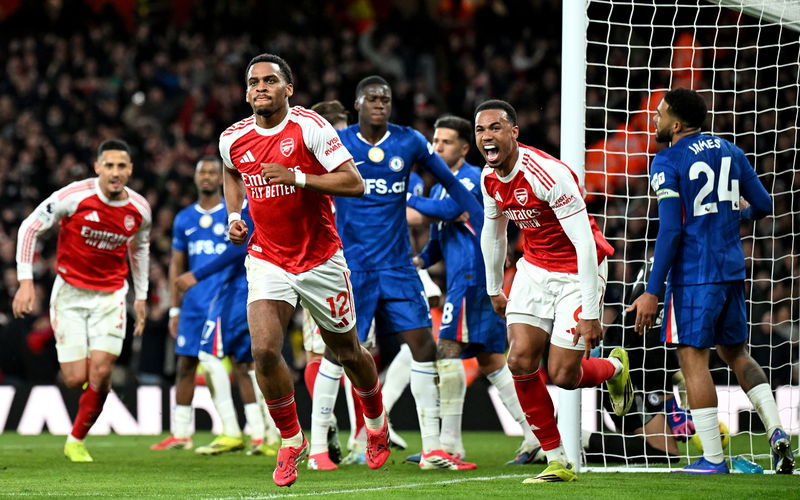
For the better part of two decades, the halls of Arsenal Football Club were filled with a quiet, dignified resignation. Under the late-Wenger era and the confused transition of Unai Emery, the club was often mocked—not out of fear, but out of pity. However, as Mikel Arteta’s project has moved from “the process” to a tangible reality, the tone of the national conversation has shifted. The pity is gone, replaced by a sharp, jagged edge of scrutiny that borders on the pathological.
A recent, explosive debate on talkSPORT between Arsenal legend Emmanuel Petit and Simon Jordan serves as a perfect microcosm of this phenomenon. It isn’t just “paranoia,” as Jordan suggests; it is a documented disparity in how Arsenal is framed compared to their rivals. When Petit exclaims he is “tired of it,” he is giving voice to a fan base that has watched the media goalposts move for five consecutive years.
1. The Rosenior paradox: A masterclass in losing
If you want to see the media bias in its purest form, look no further than the recent Carabao Cup semi-final between Arsenal and Chelsea. Chelsea, under Liam Rosenior, arrived with a defensive setup that was described by commentators in reverent tones typically reserved for peak Arrigo Sacchi.
Despite losing the tie 4-2 on aggregate, the narrative was centred on Rosenior’s “bravery” and “nuanced preparations.” After the second leg at the Emirates—a match Arsenal won 1-0 via a late Kai Havertz goal—the punditry focus wasn’t on Arsenal’s dominance or their progression to Wembley. Instead, the airwaves were filled with praise for Rosenior’s “game plan” and his “second-half control.”
This is the ultimate double standard. When Mikel Arteta uses similar pragmatism to secure results at the Etihad or Anfield, he is labelled “anti-football” or “cowardly” by the likes of Roy Keane. Yet, when Rosenior does it to lose, he is heralded as a “master tactician.” The media has decided that Rosenior represents “intellectual football,” while Arteta’s identical tactics are simply “annoying.”
2. Respect and the “Etiquette” trap
The Carabao Cup semi-final also gave us the “Warm-up Incident.” Liam Rosenior was seen angrily shouting at Arsenal players and coaches to “stay in their f***ing half” because they were supposedly encroaching on Chelsea’s territory. In the post-match press, he doubled down, lecturing the media on “footballing etiquette” and “respect.”
The media response was fascinating. Rosenior was portrayed as a guardian of the game’s values—a passionate leader demanding respect for his squad. Now, imagine for a second if Mikel Arteta had screamed profanities at opposition players during a warm-up. The narrative would immediately shift to “Arteta losing his head,” “lack of class,” or “unnecessary touchline histrionics.” For Rosenior, it’s leadership; for Arteta, it’s evidence of a “flawed character.”
3. The Amorim myth: A study in political capital
This brings us to the most frustrating disparity of 2026: the comparison between Mikel Arteta and Manchester United’s Ruben Amorim. Sir Jim Ratcliffe recently cited Arteta’s “miserable” start as a reason to grant Amorim a three-year grace period.
However, the “Amorim vs. Arteta” framework is a statistical lie. After 50 games in charge, the numbers are not even close:
-
Arteta: 27 wins (54%), 18 clean sheets, and two trophies (FA Cup, Community Shield).
-
Amorim: 19 wins (38%), 8 clean sheets, and a 15th-place league finish—United’s lowest since 1974.
Why is the media so eager to protect Amorim while they were so desperate to sack Arteta? It is about “political capital.” Arteta, a young manager who spoke of “processes” and “cultural overhauls,” challenged the media’s desire for instant chaos. Amorim is being gifted “time” based on a narrative of “institutional mess” that apparently didn’t apply to the post-Wenger Arsenal.
4. The “Set Piece FC” narrative: Moving the goalposts
One of the most glaring examples of this bias discussed by Petit is the “Set Piece FC” label. Historically, the media criticised Arsenal for being “too soft.” The narrative was that Arsenal lacked the “grittiness” of a championship-winning side.
Now that Nicolas Jover has transformed Arsenal into the most efficient set-piece unit in Europe, the media framing has shifted from “efficiency” to “limitation.” As Petit noted, after the recent derby win against Chelsea, the headlines focused almost exclusively on set-play goals rather than tactical dominance. This is a classic media trap: when Arsenal wins with flair, they are called fragile; when they win with efficiency, they are called boring. It is a “heads they win, tails Arsenal loses” framework.
5. Structural Bias and “Social media poison”
A poignant moment in the talkSPORT debate came from a caller named Dom, who highlighted how the media leverages Arsenal’s massive global fan base to generate “hate-clicks.” Because Arsenal has one of the largest and most engaged social media followings in the world, negative news about the club is more profitable than positive news.
Simon Jordan argues this is just “media content,” but this ignores the psychological impact. When pundits like Jason Cundy openly admit to wanting Arsenal to fail, it creates an environment where every 50/50 decision or refereeing mistake is viewed through a lens of Arsenal “bottling it” rather than objective sport. The “bottling” narrative is a lazy go-to that requires no tactical analysis, only a desire to see the “noisy” fans silenced.
6. The double standard of physicality: Martinelli vs. The Rest
Another caller, John, brought up a definitive proof of bias: the treatment of Gabriel Martinelli. Martinelli was “hammered” by pundits for a nudge on Connor Bradley, framed as a sign of petulance. Yet, in the same weekend, Newcastle’s Dan Burn was seen physically lifting a player and throwing them off the pitch with almost zero media blow back.
Arsenal players are framed as “ill-disciplined” for the same actions that are labelled “passion” or “intensity” in other squads. This isn’t just a difference of opinion; it is a disparity in the “disciplinary narrative” that seeps into the subconscious of referees and fans alike.
7. George Graham and the 1989 blueprint
To understand why this bias exists, we have to look at the club’s DNA. As Dom reminded the listeners, George Graham utilised this exact media hatred in 1989. Before the legendary night at Anfield, Graham told his players: “Everyone hates us. The media hates us. They don’t want us to win it.”
By framing the media as the enemy, Graham created a “Siege Mentality.” Arteta appears to be doing the same. By leaning into the “ridicule,” the squad has become an insular, unbreakable unit. The media’s desire to see Arsenal trip up—citing their 22-year drought as a reason they “can’t” win—is actually providing the fuel for the current title charge.
8. The entitlement myth
Simon Jordan’s most telling comment was that Arsenal fans have a “sense of entitlement.” This is the root of the media’s bias. They view Arsenal’s resurgence as an intrusion. The “pundit class,” largely dominated by stars of the 90s who enjoyed dominance over Arsenal, finds it difficult to adjust to a world where Mikel Arteta—a man they once laughed at—is tactically outclassing their own former clubs.
They see “entitlement” where there is actually just “belief.” When Arsenal fans defend their team, they are called “toxic” or “paranoid.” When other fan bases do it, they are “passionate.” This linguistic gymnastics is the engine that drives the anti-Arsenal machine.
Conclusion: The wind in the sails
Emmanuel Petit is right to be “tired of it.” The negativity isn’t based on the “facts” of the table—where Arsenal has led since October—but on a “feeling” that Arsenal doesn’t belong at the summit.
As we approach the final nine games of 2026, the media will continue to search for the “dark stories.” They will highlight the set pieces, they will pray for the “bottle” to pop, and they will amplify every minor mistake. But as the 1989 squad proved, there is no greater motivation than proving a biased room wrong. For Arteta’s Arsenal, the media’s bias isn’t a hurdle—it’s the wind in their sails. If they lift the trophy in May, they won’t just be beating Manchester City; they will be defeating a media framework designed to see them fail.