

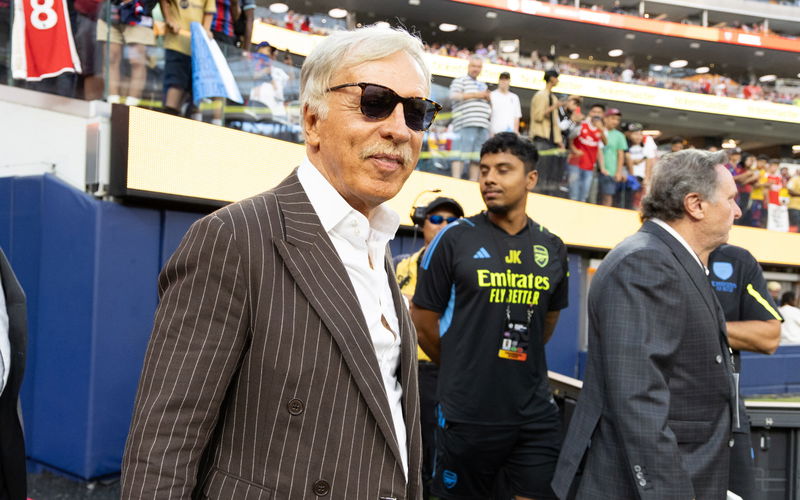
For over a decade, the mention of “Kroenke” at the Emirates Stadium was met with a mixture of apathy and open hostility. The “Silent Stan” era was defined by the infamous self-sustaining model a period where Arsenal felt like a stagnant cash cow for a distant American billionaire. Fans watched with a sense of helplessness as the club’s rivals, backed by state wealth or aggressive local investment, pulled ahead in a race Arsenal seemed unwilling to run.
But as we sit in February 2026, the scenery has undergone a seismic shift. The apathy has been replaced by a ruthless ambition, and the hostility by a cautious, results-driven respect. To understand how we got here, we have to look past the goals and the trophies. We have to follow the money, analyse the debt, and understand the “SoFi” blueprint that has turned the Gunners into a financial and tactical juggernaut.
1. The consolidation era (2018–2021): Taking the handbrake off
The true start of the redemption arc wasn’t a world-record signing; it was a boardroom buyout. In August 2018, KSE (Kroenke Sports & Entertainment) paid roughly £550 million to acquire Alisher Usmanov’s 30% stake, finally taking the club private and ending a decade-long cold war for control.
The end of the “self-sustaining” prison
Under the previous “public” model, Arsenal operated on a strict “eat what you kill” basis. Every penny spent on transfers had to be generated by the club’s own operations, and every major decision was subject to the scrutiny of minority shareholders who were often more interested in political manoeuvring than league standings.
Taking the club private provided the structural flexibility Stan and Josh Kroenke needed. It allowed the club to move away from the “Self-Sustaining Model” that fans loathed a model that worked for a top-four finish in 2012 but was a death sentence in the hyper-inflated market of the 2020s.
The debt refinancing masterstroke (2020)
In 2020, amidst the global pandemic, KSE made a move that was largely ignored by the mainstream media but changed the club’s trajectory forever. They refinanced the stadium debt. Previously, Arsenal was beholden to rigid bank bonds that required massive cash reserves roughly £37 million to sit idle in a bank account as a “debt service reserve.” By moving this debt to a KSE-backed loan, that “dead money” was instantly liquidated. It wasn’t “free money,” but it was the capital that allowed Arsenal to keep spending while other clubs were tightening their belts.
The super league nadir and the pivot
If 2018 was about ownership, 2021 was about survival. The European Super League fiasco was the absolute lowest point for the KSE-Arsenal relationship. The protests outside the Emirates weren’t just about football; they were about a total breakdown in trust.
However, the aftermath saw a radical shift. Josh Kroenke became the “boots on the ground,” attending fan forums and promising that KSE would act as “aggressive lenders.” They realised that to protect their multi-billion-dollar asset, they could no longer manage for profit they had to manage for trophies.
2. The spending spree (2022–2026): Setting the market
The “Trust the Process” era would have been impossible without the financial muscle to back Mikel Arteta’s vision. The shift in risk appetite from KSE has been nothing short of staggering. Arsenal transitioned from “shopping for bargains” to “setting the market.”
The €1 billion threshold
By early 2026, Arsenal’s five-year net spend has consistently outpaced almost every rival in world football. While clubs like Chelsea spent sporadically and chaotically, Arsenal’s investment was surgical.
-
The Rice benchmark: The £105 million for Declan Rice was the ultimate statement. Arsenal were no longer waiting for stars to develop; they were buying established world-beaters to lock down the “spine” of the team.
-
The “Floor Raisers”: Investment in players like Kai Havertz, Gabriel Jesus, and Jurrien Timber represented a shift toward high-floor, high-ceiling profiles that ensured the team could “absorb the shocks” of a long season.
The Deloitte leap: 7th in the world
The financial data published in early 2026 highlights the success of this aggression. According to the Deloitte Football Money League 2026, Arsenal has rocketed to a revenue of €821.7 million, placing them 7th in the world.
-
Match day revenue: Hit a record €183 million, the highest in London.
-
Commercial revenue: Reached €314 million, a staggering 124% increase since 2021.
-
Wage efficiency: Most impressively, the club’s wages-to-revenue ratio dropped from a bloated 73% in 2021 to a healthy 53% by 2025. By clearing out “deadwood” contracts (Ozil, Aubameyang, Pepe), the club created a wage structure that actually rewards performance rather than past reputation.
-
3. The “SoFi” Blueprint: The Multi-Sport Mastery
To understand the “New Arsenal,” you have to look at Denver and Los Angeles. KSE is no longer just a passive owner; they are a championship machine that applies a specific blueprint to every franchise they own.
The championship streak
Between 2022 and 2024, Kroenke’s teams achieved a feat never seen before in professional sports. The LA Rams (NFL) won the Super Bowl, the Colorado Avalanche (NHL) won the Stanley Cup, and the Denver Nuggets (NBA) won the Finals.
The “SoFi blueprint” is simple:
-
Identify the architect: Find a young, tactically innovative leader (the Sean McVay/Mikel Arteta figure).
-
Patience during the foundation: Give them three years of absolute protection during the “Cultural Reset.”
-
Aggressive capital injection: Once the “core” is ready to win, loosen the purse strings and spend whatever it takes to cross the finish line.
Arsenal fans are now witnessing Phase 5 of this blueprint: Sustained Success and Silverware.
4. The PSR shield: Why Arsenal isn’t Everton
While rivals like Everton, Nottingham Forest, and even Manchester City have been hamstrung by Profit and Sustainability Rules (PSR), Arsenal has remained remarkably untouched. This is the “PSR Shield.”
Commercial engineering
The club’s commercial team, led by hires from elite clubs like AC Milan and Liverpool, has professionalised Arsenal’s brand.
-
The Sobha realty deal: Selling naming rights to the London Colney training ground was a genius move to generate “pure profit” revenue.
-
The Adidas/Emirates renewals: These deals were timed perfectly with the club’s return to the Champions League, ensuring maximum leverage.
The academy economy
The sales of academy graduates like Emile Smith Rowe and Eddie Nketiah provided “pure profit” on the balance sheet. In the world of PSR, selling a £30m academy player allows you to amortise a £150m incoming transfer over five years. This “Hale End Economy” has become the engine that fuels Arsenal’s ability to keep buying superstars.
5. The “Emirates 2.0”: Reclaiming the throne of London
The final, most audacious chapter of the redemption arc is currently being written in steel and concrete. As of 2026, the club has initiated a feasibility study for a massive expansion of the Emirates Stadium.
The 80,000-seat vision
The goal is to increase capacity from 60,700 to as many as 80,000 seats.
-
Meeting the demand: With a season ticket wait list exceeding 100,000 names, the demand is limitless.
-
The financial impact: An 80,000-seat stadium would push match day revenue toward £220 million per year, surpassing both Tottenham and Manchester United and placing Arsenal in the same stratosphere as Real Madrid.
-
The Wembley relocation: This project would likely require Arsenal to play at Wembley Stadium for up to two seasons. While a logistical hurdle, it is a clear sign that KSE is finally prioritising the next 50 years over the next five.
6. Editorial: From villain to visionary?
Did Stan Kroenke grow a heart? Has he suddenly become a “super-fan” who bleeds red and white? Almost certainly not. Stan Kroenke is a billionaire businessman focused on asset growth.
However, the genius of the last five years is that KSE realised a fundamental truth about modern football: The most valuable clubs are the ones that win. ### The Cost of Ambition In 2018, Arsenal was valued at roughly $2.3 billion. By early 2026, that valuation has surged to $4.2 billion. Kroenke didn’t “give” Arsenal money; he invested in his own asset. By subsidising six consecutive years of losses (totalling over £328 million) to facilitate the rebuild, KSE proved they were willing to eat short-term pain for long-term dominance.
The verdict: A new social contract
The “Kroenke Redemption” isn’t based on love; it’s based on a new social contract. The fans provide the atmosphere and the global “eyeballs” that drive commercial revenue; the owners provide the cold, hard capital required to hunt down the Manchester City machine.
As the plans for an 80,000-seat stadium gather pace and the revenue continues to break records, the message to the rest of the Premier League is clear: The “Self-Sustaining” handbrake is off. Stan and Josh Kroenke didn’t just buy Arsenal; they finally decided to lead them.
Closing Thoughts
The “Trust the Process” era has been about more than just a manager’s tactics. It has been about a total structural overhaul of a club that had forgotten how to be elite. The finances of 2026 tell a story of a club that has moved past the “Fear of Failure” and embraced the “Cost of Ambition.” Whether you love the owners or not, one thing is undeniable: Arsenal are finally acting like the giants they always claimed to be.
Featured image courtesy of Getty Images