

Wembley Way on Sunday, March 22nd, was a moving tapestry of hope. We arrived in droves—thousands descending from the Seven Sisters Road and millions more tuning in globally—expecting to see the coronation of Mikel Arteta’s modern Arsenal. We expected a team that finally knew its own skin; a team defined by “control,” “duels,” and an unshakeable tactical identity.
For forty-five minutes, we got exactly that. It was a knife-edge stalemate, a high-stakes chess match between Arteta and Pep Guardiola that some neutrals might have called “boring” or “ugly,” but we knew better. It was a tactical masterclass. But by the time the full-time whistle echoed under the arch, the “Process” hadn’t just stalled; it had suffered a total mechanical failure. In a harrowing second-half display, Arsenal didn’t just lose a trophy; they lost their senses.
1. The team sheet that cost a trophy
The post-mortem of this final begins and ends with the team sheet. In elite football, there is a fine line between rewarding loyalty and committing tactical suicide. By choosing Kepa Arrizabalaga over David Raya, Mikel Arteta crossed that line.
The logic, presumably, was to reward the “cup goalkeeper” who had played in the earlier rounds. But Manchester City is not a “cup opponent”; they are a relentless machine that identifies and exploits the slightest atmospheric pressure drop. Raya has been the heartbeat of our defensive transition all season, providing the security and elite distribution that allows our high line to function.
Kepa, despite his experience, is a different profile. He is a traditional shot-stopper whose relationship with the ball at his feet is one of necessity, not natural flair. When the team sheet was announced, a collective shiver ran through the travelling support. It felt like a gamble we didn’t need to take—a sentiment-driven decision in a world that only rewards cold-blooded efficiency. In hindsight, Kepa should never have been standing between those sticks at Wembley.
2. The Illusion of control: The first half stalemate
The first half was a testament to how far this squad has come. We matched City stride for stride. The strategic setup was disciplined, forcing Erling Haaland into peripheral areas and limiting City to a single header over the bar.
The sliding doors moment arrived in the 10th minute. A flowing move, quintessential of this “new” Arsenal, carved City open. The ball fell to Kai Havertz. In that moment, we needed the clinical edge of a champion. Instead, Havertz couldn’t find the finish to match the build-up. Had that hit the back of the net, the psychological weight would have shifted. Instead, it served as a harbinger of the lack of “killer instinct” that would eventually haunt the afternoon.
Going into the tunnel at 0-0, most fans would have been happy. We had the better chances; we looked comfortable. But the second half proved that “comfort” is a dangerous illusion when facing a Guardiola side that can shift through gears while you are still looking for the clutch.
3. The anatomy of a collapse: “gear one” Football
What happened next was a collective surrender. City came out all guns blazing, and Arsenal was left planting both feet on the ground, struggling to breathe.
The moment of “rush of blood”
The game swung on the 59th minute. A high, bouncing ball lured Kepa out of his area. It was a moment of pure “rush of blood”—a goalkeeper trying to be a sweeper without the necessary timing. He found himself wrestling with City Captain Bernardo Silva on the edge of the box, leaving an open goal behind him. From that second on, as an Arsenal fan, I started to get itchy and nervous. We were stuck in gear one, and it felt like the bicycle chain was jammed.
The Nico O’Reilly double
Ten minutes later, the calamity was complete.
-
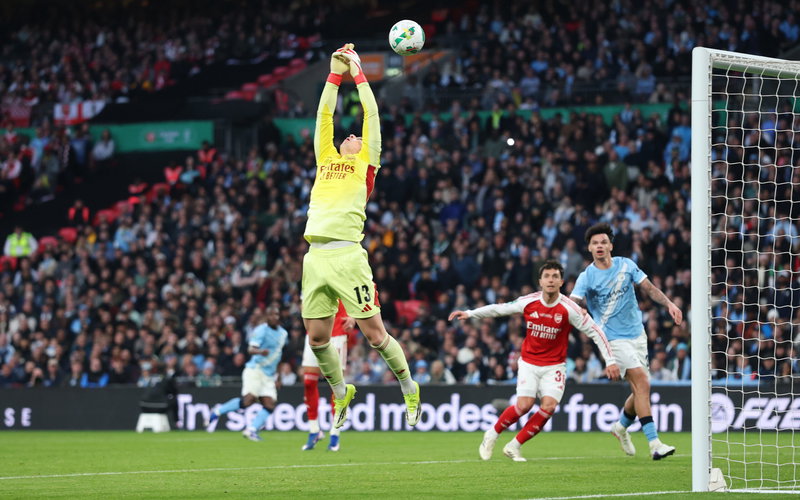
The Fumble: Rayan Cherki delivered a cross from the byline. It was a routine claim for a keeper of this level, yet the ball slipped through Kepa’s hands like a bar of soap. It landed perfectly for Nico O’Reilly, who ghosted goal-side of Bukayo Saka to nod it into the net.
-
The Repeat: Five minutes later, the nightmare recurred. This time, a cross from Matheus Nunes sailed over Kepa’s head. Again, O’Reilly was there to punish us. Two goals, both headers, both born from the keeper’s inability to command his area.
4. The keeper contrast: The Raya vs. Kepa paradox
To understand why this collapse happened, we must look at the technical disparity between our two options. Arteta’s system is not just about defending; it is about “goalkeeping as a play maker.”
The “Safety Net” of David Raya
When David Raya is in goal, the defence plays with a specific posture. They know that if the press gets too tight, Raya can ping a 40-yard ball to the chest of Gabriel Martinelli. They know his positioning on crosses is proactive—he catches the ball, he doesn’t punch it. This creates a “safety net” that allows Saliba and Gabriel to push higher, squeezing the game.
The “Anxiety Loop” of Kepa
Kepa, by contrast, triggered what I call the “Anxiety Loop.” Because his distribution is slower, the defenders had to drop five yards deeper to provide easier passing lanes. This created the very space in the midfield that City exploited. The technical error for the goals was bad, but the tactical error of changing the “base” of the team for a final was worse. Arteta essentially asked the team to play a different sport with a different anchor, and the anchor snapped under the first sign of pressure.
5. Media narratives and the “Patience” disparity
This defeat brings us back to a recurring theme: the narrative surrounding Mikel Arteta’s “Process” and the massive capital—both financial and political—that he has been afforded.
For years, we have been told to “Trust the Process.” Arteta was allowed to finish 8th twice, allowed to move on massive stars like Ozil and Aubameyang, and given hundreds of millions to rebuild the squad. The media narrative has often been one of “inevitable growth.” However, a performance like Sunday’s calls into question whether that patience has made the team—and the manager—too comfortable.
When you compare the “time and patience” given to Arteta to the cut-throat nature of other elite clubs, the disparity is glaring. We have been waiting for the “big trophy” to justify the years of rebuilding. When you get to the final and falter because of a self-inflicted selection error, the “Process” starts to look less like a blueprint and more like a shield against criticism.
6. Tactical rigidity and the bench crisis
The loss also highlighted a glaring issue with our squad depth. While City can bring on world-class quality to change a game, Arsenal’s bench felt like a step down rather than a step up.
-
In-Game Management: As City cranked up the pressure, Arteta seemed frozen. The tactical shift required a keeper who could bypass the press, but we were wedded to a strategy that Kepa couldn’t execute.
-
The Striker Problem: Without a clinical, “Plan B” striker to come off the bench, we were forced to watch Havertz struggle for 80 minutes. The lack of real quality in reserve meant that once the system broke, we had no way to fix it on the fly. We missed a physical presence—someone who could have bullied the City defence when the “tactical masterclass” turned into a scrap.
Conclusion: A lesson in ruthlessness
The “Trust the Process” era has brought us to the top of the Premier League, but Wembley was a reminder that the process is still vulnerable to sentimentality.
We saw a team lose its senses and its confidence in a 45-minute span. To see a “tactical masterclass” dissolve into a “calamity show” is a bitter pill for every Gooner to swallow. We travelled in hope, but we left Wembley with a stark reminder: to beat the best, you cannot afford to get the team sheet wrong.
The chain is off the bike. The question now is whether Arteta can put it back on in time for the final sprint of the season, or if this Wembley collapse marks the beginning of a much larger demise.