

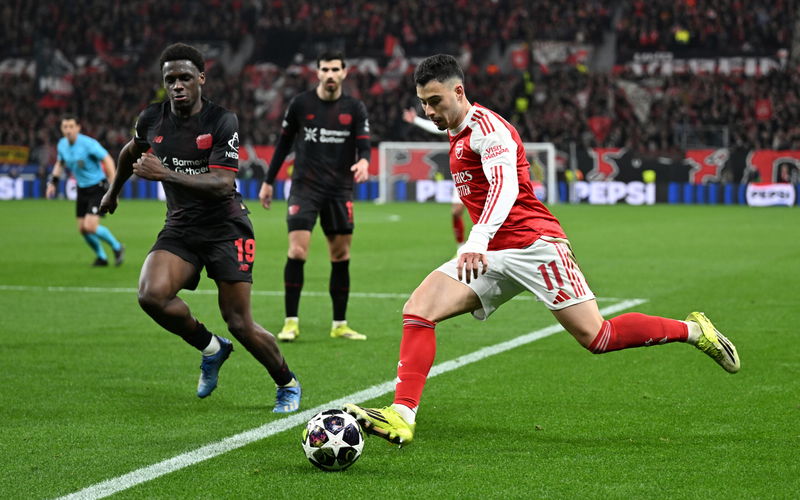
In the cold, clinical air of the BayArena on the night of March 11, 2026, the footballing world witnessed something rare in the modern Mikel Arteta era: a stutter. For a team currently perched at the summit of the Premier League and chasing a historic four-trophy haul, the 1-1 draw against Bayer Leverkusen felt less like a tactical chess match and more like a desperate, collective gasp for air.
As the Gunners prepare for a Carabao Cup Final against Manchester City on March 22 and a high-stakes FA Cup Quarter-Final against Southampton on April 4, the question is no longer just about talent, tactics, or “The Process.” It is about the human limit. It is about how much the physical body and the psychological spirit can endure when the weight of expectation becomes a physical burden.
The BayArena mirage: expectation vs. reality
On paper, tonight’s Champions League Round of 16 first leg looked like a foregone conclusion. Arsenal arrived in North Rhine-Westphalia with a lineup that radiated strength. With Viktor Gyökeres leading the line, Eberechi Eze pulling the strings, and a defence led by William Saliba that has been the meanest in Europe all season, the narrative was set. Fans and analysts alike weren’t asking if Arsenal would win, but by how many goals they would lead going back to the Emirates.
What followed was a jarring reality check. The performance was “jedded”—a term fans are increasingly using to describe this specific brand of heavy-legged, sluggish display. It was a showcase of misplaced passes, a vanished press, and a startling lack of “zip.” The signature “Arteta Press,” which usually functions like a high-voltage cage, was replaced by a lukewarm simmer.
Bukayo Saka, often the heartbeat of the attack and the most durable player in the squad, looked uncharacteristically off the pace before being substituted in the 70th minute. Even the most basic five-yard rotations seemed to require an immense cognitive effort. It took a controversial 89th-minute penalty from Kai Havertz, returning to his former stomping ground, to rescue a draw after Robert Andrich had exploited Arsenal’s fatigue early in the second half. While the scoreline reads “Score Draw,” the “eye test” told a story of a team running on fumes.
The anatomy of pressure: Why being at the top is different
Leading the pack isn’t just about the points on the board; it’s about the target on your back. For Arsenal, being at the “summit” means every domestic and European opponent views them as the ultimate scalp. There are no “low-stakes” games anymore.
1. The physical toll (The “Overload”)
Arsenal’s system is notoriously demanding. Arteta’s philosophy relies on “Total Control,” which requires every player to maintain specific distances and trigger presses within seconds of losing possession. When fatigue sets in, these distances increase by just a few inches—but in elite football, inches are miles. Tonight, Leverkusen found pockets of space that simply shouldn’t exist in an Arteta-coached side.
2. The Mental Fog
Fatigue isn’t just in the hamstrings; it’s in the brain. The “mental drain” of having to be perfect for 90 minutes, three times a week, leads to “decision-making paralysis.” We saw it tonight: Rice holding the ball a second too long, Gabriel opting for a long ball instead of a line-breaking pass, and the front line failing to anticipate the second ball.
The pundit’s verdict: “fighting the calendar”
The reaction from the media was swift, focusing heavily on the “quadruple load.” Speaking on the Sky Sports post-match panel, Jamie Carragher provided a sobering analysis of the performance:
“We are seeing the cost of greatness. When you’re at the top, every opponent plays their ‘Cup Final’ against you. Arsenal aren’t just fighting Leverkusen; they are fighting the calendar. That misplaced energy isn’t a lack of quality; it’s a lack of oxygen to the brain caused by 50 games of high-intensity football. You saw it tonight—they weren’t just missing tackles; they weren’t even arriving for them.”
Former Arsenal legend Thierry Henry echoed these sentiments on CBS Sports, highlighting the psychological mountain the squad is currently climbing:
“To lead the Premier League while eyeing three other trophies is a psychological mountain. You saw it in their eyes tonight—they looked mentally drained. When you are on that pedestal, everyone wants to lock you off it. Eventually, the weight of being the hunted starts to buckle the knees. This wasn’t a tactical failure; it was a human one.”
The “four-competition” paradox
No English team has ever managed the “True Quadruple” (Premier League, Champions League, FA Cup, and League Cup). The reason is simple: the schedule eventually breaks you. Arsenal are currently surviving on a knife-edge.
Mikel Arteta has been prophetic about this. Earlier this season, he famously made a “passionate plea” to the Premier League to increase match day squad sizes to 20 players to protect player mental health and welfare.
“Every week we have to tell someone they aren’t even allowed to travel,” Arteta explained. “We are pushing these boys beyond what is reasonable.”
Tonight, that internal friction—coupled with the gruelling travel to Germany—seemed to manifest in a lack of cohesion. The “patience” that Arteta has asked for over the years is now being tested not by the fans’ lack of belief, but by the players’ lack of recovery time.
Comparative pressure: How the giants cope
To understand the magnitude of Arsenal’s task, we must look at the few who have come close to this level of dominance.
Manchester City (The 2023 Blueprint)
Pep Guardiola’s Treble-winning side utilised what sport scientists call “Tactical Periodisation.” They knew when to play at 70% intensity. In games against lower-half opposition, City would “rest with the ball,” keeping possession without necessarily attacking. Arsenal, however, seem to have only one gear: 100%. Tonight, they tried to play at 100% but only had 60% in the tank.
Liverpool (The 2022 Burnout)
In the 2021/22 season, Jurgen Klopp’s Liverpool chased the quadruple until the very last week of May. They won both domestic cups but lost the Premier League by a point and the Champions League final by a single goal. The aftermath was a season of massive regression due to physical and emotional burnout. This is the “ghost” that haunts Arsenal’s current run—the fear that chasing everything might leave them with nothing.
| Team | Strategy | Outcome |
| Man City (2022/23) | “Tactical Periodisation” & heavy rotation. | Won the Treble. |
| Liverpool (2021/22) | Relentless “Mentality Monsters” approach. | Won 2 Cups; Runner-up in PL/UCL. |
| Arsenal (Current) | Reliance on fixed core & late tactical shifts. | In Progress. |
The road ahead: Wembley and the south coast
The draw in Leverkusen serves as a vital bridge to the most defining fortnight of the season. The result remains a “score draw,” giving Arsenal the advantage of finishing the job at the Emirates next week. However, the path is littered with landmines.
1. The league grind
Maintaining a lead at the summit of the Premier League requires perfection every weekend. There is no room for a “Leverkusen-style” performance against teams like Everton or Chelsea.
2. The Wembley showdown (March 22)
The Carabao Cup Final against Manchester City is the first chance for silverware. It is a psychological crossroads. A win validates the exhaustion; a loss makes the fatigue feel twice as heavy. To beat City, Arteta needs a version of Arsenal that didn’t show up in Germany tonight.
3. The Southampton trap (April 4)
The FA Cup Quarter-Final at St. Mary’s is a classic “banana skin” game. Southampton will be fresher, having had fewer midweek European commitments. For Arsenal, it will be about “finding a way” when the flair is gone.
Player perspective: The mental fatigue
In the mixed zone after the Leverkusen game, a tired-looking Declan Rice summed up the mood:
“We’re human. We want to win everything for the fans, but you can feel the games in your legs. Tonight wasn’t us. We misplaced passes we usually make in our sleep. But we got the draw, and we take that back home.”
This honesty is refreshing but alarming. When your leaders admit the “legs are gone,” the manager must look to his bench. The disparity in “financial and political capital” between Arsenal and a state-backed City means Arsenal’s squad depth, while improved, is still being pushed to its absolute breaking point.
Conclusion: The survival of the fittest
While the BayArena performance was lacklustre, it is important to remember that champion teams are defined by their “ugly” results. Coming away from North Rhine-Westphalia with a 1-1 draw despite being “mentally drained” and “fatigued” is, in its own way, a victory.
Arsenal are on a pedestal that every other team wants to “lock them off.” The narrative surrounding Arteta has shifted from “Trust the Process” to “Can he handle the Pressure?” Unlike Ruben Amorim or other managers who are often compared to him, Arteta is operating in a pressure cooker that has no relief valve. He is fighting for four trophies simultaneously—a feat that requires more than just good coaching; it requires a medical and psychological miracle.
The “energy and pres” that defined their autumn surge may be flickering, but the flame is not out. The road to Wembley, the second leg at the Emirates, and the final stretch of the Premier League will determine if this Arsenal team are merely “contenders” or if they are “immortals.”
The quadruple is a dream, but as tonight proved, it is a dream that threatens to become a marathon with no finish line in sight. For the fans, the message is clear: the team is tired, the players are fatigue-stricken, but they are still leading. Now, more than ever, the Emirates must become the second wind that this exhausted squad so desperately needs.