

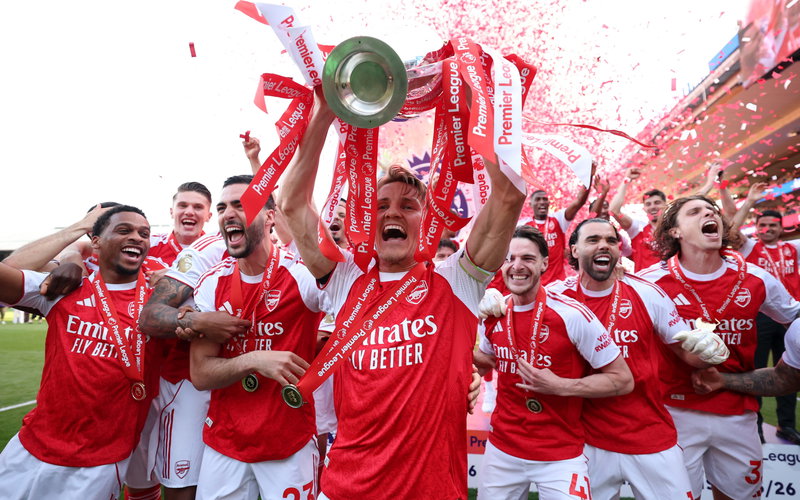
Introduction: The red and white delirium
On the evening of Tuesday, 19th May 2026, London did not sleep. The capital’s transport network ground to a halt as an estimated half a million people descended upon North London, turning the streets surrounding the Emirates Stadium into a cascading sea of red and white scarves, billowing flags, and pyro smoke. This was not a pre-planned weekend parade; this was a spontaneous, primal release. The confirmation had flashed across screens just after 9:30 PM BST: Manchester City, Arsenal’s relentless modern tormentors, had been held to a gruelling 1-1 draw away against a brilliant, in-form Bournemouth side at the Vitality Stadium. With that result, Arsenal opened an unassailable four-point lead at the top of the table on 82 points, rendering the final weekend a purely ceremonial lap of honour.
Five days later, on Sunday, 24th May 2026, the emotional climax reached its formal crescendo. Though the final whistle of the campaign blew away from home at a raucous Selhurst Park, the travelling Arsenal support completely took over the stadium in south London. Standing before a bouncing away end, club captain Martin Ødegaard hoisted the Premier League trophy into the afternoon sky, completing a coronation 22 years in the making—stretching all the way back to Arsène Wenger’s legendary 2003/04 ‘Invincibles’.
Yet, the shock waves of this triumph reverberated far beyond the borders of the United Kingdom. For observers who historically undervalued the sheer scale of Arsenal’s international footprint, the global scenes were staggering. In Nairobi, Kenya, and Kampala, Uganda, thousands of fans organised mock trophy parades, complete with replica open-top buses and brass bands. Similar makeshift street parties blocked traffic in Bangkok, Thailand, and across major cities in the United States.
   [ The 22-Year Metamorphosis ]

   2004: Wenger's Invincibles (The Peak)
     │
     ▼ (Decade of Financial Austerity & Fractional Ownership)
   2018: KSE Achieves 100% Full Ownership
     │
     ▼ (The Nadir)
   2021: ESL Crisis, Fan Protests, 8th-Place Finishes, Aubameyang Fall-out
     │
     ▼ (The Pivot: "Trust the Process" & Corporate Realignment)
   2026: Premier League Champions under Mikel Arteta
Behind this global sporting empire sits Kroenke Sports & Entertainment (KSE). Once caricatured as greedy, detached American tycoons who were actively ruining the club through corporate negligence and a profound lack of ambition, the Kroenke family—spearheaded by Stan and his son, Josh—have completed one of the most astonishing reputational turnarounds in sporting history. By blending ruthless commercial modernisation with extraordinary sporting patience, KSE has transformed Arsenal from a fractured, cynical institution into a commercial beast of a machine and the envy of club owners worldwide.
Part I: The wilderness years and the myth of ‘Silent Stan’
To appreciate the scale of the coronation in May 2026, one must revisit the absolute nadir of the Kroenke regime. Stan Kroenke first bought a stake in Arsenal in 2007, gradually building his shareholding until KSE forced a mandatory buyout of minority shareholders in August 2018, valuing the club at £1.8 billion. For the local match-going fan base, this transition from a traditional custodial board to sole American ownership was viewed with existential dread.
For years, the moniker ‘Silent Stan’ was weaponised by the Arsenal Independent Supporters’ Trust (AST) and pundits alike. The ownership was accused of treating the club as a passive asset or a ‘cash cow’—happy to collect the lucrative distributions of Champions League qualification under late-era Arsène Wenger without ever risking capital to challenge for the highest honours.
When Wenger departed and the club slid into the Europa League wilderness under Unai Emery, the lack of an overarching corporate strategy became glaringly obvious. The team lacked direction, the squad was bloated with highly paid, under performing talent, and the commercial revenue stagnated relative to rivals Manchester City and Manchester United. The fans felt completely alienated, viewing KSE as absentee landlords who did not understand the cultural fabric of English football.
Part II: The Nadir—The super league and the civil war of 2021
The boiling point occurred in April 2021. Without any consultation with fans, staff, or football governing bodies, Arsenal was announced as one of the twelve founding members of the ill-fated European Super League (ESL). The project sought to establish a closed-shop competition, separating Europe’s elite clubs from the meritocracy of their domestic leagues.
The backlash from the UK fan base was immediate, fierce, and highly coordinated. Thousands of furious supporters marched on the Emirates Stadium ahead of a Premier League fixture against Everton, hanging effigies of Stan Kroenke and chanting “We want Kroenke out!” The beautiful game was facing a cultural civil war, and Arsenal fans stood on the front lines to defend their club’s heritage.
Recognising the catastrophic miscalculation, KSE retreated within 48 hours, issuing a formal, humbled retraction and removing Arsenal from the ESL planning. However, the damage to their reputation seemed permanent.
Compounding the off-field fury was a bleak on-field reality. Arsenal were enduring the dark winter of the COVID-19 pandemic, playing inside empty, echoey stadiums. Mikel Arteta, appointed in late 2019, was struggling to steer a fractured dressing room. The club was limping toward a second consecutive eighth-place finish, missing out on European football entirely for the first time in a quarter of a century.
Furthermore, the club was embroiled in internal disciplinary drama. Club captain and leading goalscorer Pierre-Emerick Aubameyang was stripped of his captaincy following repeated disciplinary breaches and subsequently exiled from the first team. To the outside world, Arsenal looked derisory. The squad lacked top-tier quality, technical director Edu Gaspar was under fire, and the fan base was deeply divided over ticket pricing structures during an economic downturn. It was an institution in administrative and sporting decay.
Part III: The turning point—The Geoff Shreeves interview
In November 2021, with Spotify billionaire Daniel Ek launching a highly publicised £1.8 billion takeover bid backed by club legends Thierry Henry, Patrick Vieira, and Dennis Bergkamp, KSE decided to break their silence. Josh Kroenke sat down with Sky Sports pundit Geoff Shreeves for an exclusive, highly critical interview that would ultimately age into the blueprint for Arsenal’s modern renaissance.
       [ The 2021 Crossroads ]
┌─────────────────────────────────┐
│     Daniel Ek Takeover Bid      │ ──┐
│  (Backed by Henry, Vieira, Ek)  │   │
└─────────────────────────────────┘   │   ┌──────────────────────────────────┐
                                      ├──>│  Josh Kroenke & Geoff Shreeves   │
┌─────────────────────────────────┐   │   │  Interview: "We are not selling, │
│      Post-ESL Fan Protests      │ ──┘   │  we are just getting started."   │
│   & 8th-Place On-Field Decay    │       └──────────────────────────────────┘
└─────────────────────────────────┘
Shreeves, an aggressive interviewer and an Arsenal supporter himself, did not hold back. He grilled Kroenke on the ESL betrayal, the lack of communication, and whether KSE possessed the sporting ambition required to catch Manchester City. Josh Kroenke’s response was definitive:
“Arsenal Football Club is not for sale. We are just getting started. Our goal is to win the Premier League, and we will back Mikel Arteta to the hilt to get us there. We ask our fans to trust what we are building.”
At the time, the interview was met with immense scepticism. High-profile pundits like Jamie Carragher openly mocked the corporate jargon deployed by the younger Kroenke, comparing his performance to a fictional character. Speaking on Sky Sports shortly after the interview aired, Carragher remarked:
“I think number one, I’m pleased part of the ownership has come out and spoke… But there was a little bit of David Brent in it. Vision. Strategy. For me, they are just words… Under their ownership, they’ve been in a position where they were in the Champions League and they never challenged for the league. So that for me will be the proof in the pudding.”
Carragher’s critique perfectly captured the fan sentiment of 2021: talk is cheap, and the proof would reside strictly in the sporting pudding.
Part IV: Redefining the culture—The ‘Trust the Process’ rebuild
Rather than flinching under the intense media scrutiny and fan hostility, KSE did exactly what Josh Kroenke promised Geoff Shreeves: they backed their manager with unwavering political and financial capital.
The club embarked on a ruthless cultural purge. High-earning, toxic assets were paid off to leave the club, prioritising young, hungry, technically elite characters who matched Arteta’s demanding non-negotiables. KSE financed massive summer spending sprees, sanctioning generational transfers for players who would become the spine of the 2026 title-winning team: Martin Ødegaard, Aaron Ramsdale, Ben White, Gabriel Magalhães, and later, the trans formative arrivals of Gabriel Jesus, Oleksandr Zinchenko, and the record-breaking £105 million signing of Declan Rice.
                  [ The Strategic Realignment ]

     COMPONENTS                         EXECUTIVE ACTIONS
  ┌──────────────┐             ┌──────────────────────────────────┐
  │  CULTURE     │ ──────────> │ Purge toxic assets (Aubameyang)  │
  └──────────────┘             └──────────────────────────────────┘
  ┌──────────────┐             ┌──────────────────────────────────┐
  │  FINANCIAL   │ ──────────> │ Heavy backing (Rice, Ødegaard)   │
  └──────────────┘             └──────────────────────────────────┘
  ┌──────────────┐             ┌──────────────────────────────────┐
  │  MANAGERIAL  │ ──────────> │ Absorb pressure during setbacks │
  └──────────────┘             └──────────────────────────────────┘
What set KSE apart from Roman Abramovich’s Chelsea or the chaotic executive structures at Manchester United was their absolute patience. When Arsenal narrowly missed out on the top four in May 2022 to arch-rivals Tottenham Hotspur, or when they blew consecutive late-season leads to Manchester City in the 2023/24 and 2024/25 campaigns, KSE did not sack the manager. They absorbed the external pressure, calculated the internal progression, and doubled down on their long-term investment strategy.
Part V: The commercial beast of a machine
While the footballing infrastructure was being overhauled by Arteta and Edu, KSE was quietly engineering a commercial revolution behind the scenes. They restructured Arsenal’s commercial division, turning the club into an absolute powerhouse of corporate monetisation.
By upgrading their long-term partnership with Adidas and maximising the naming rights and sleeve sponsorship’s of the Emirates airline and Visit Rwanda, Arsenal’s commercial revenues skyrocketed. The stadium became an innovative hub for match-day hospitality, premium seating revamps, and global retail integration. KSE applied the exact same administrative template that brought them championship success in the United States with the Los Angeles Rams (NFL), Colorado Avalanche (NHL), and Denver Nuggets (NBA).
Crucially, this commercial modernisation was achieved without the intervention of an artificial sovereign wealth fund or a nation-state “sugar daddy.” Arsenal became entirely self-sustaining, generating immense cash flow that allowed them to consistently comply with strict Premier League Profit and Sustainability Rules (PSR) while simultaneously outbidding European rivals for world-class talent like Declan Rice and Eberechi Eze.
Following the confirmation of the title, prominent media outlets and analysts highlighted this financial model. A lead editorial on Football365 noted:
“Arsenal have officially cashed in their receipts on the pundits who doubted them. They have completed a total systemic transformation without a sovereign state sugar daddy, showing that an analytical, patient project can still dismantle the elite hegemony of English football.”
Part VI: Global sovereignty and fan reconciliation
The scenes of late May 2026 have completely rewritten the narrative surrounding KSE’s legacy. The absolute unity between the players, the coaching staff, the executive board, and the match-going fan base is palpable. The toxic social media civil wars of the late-Wenger and Emery eras have been entirely replaced by an earned, collective euphoria.
The global parade simulations in Kenya, Uganda, and Thailand serve as undeniable evidence of how far the club’s values have shifted. Arsenal is no longer viewed as a fractured, cynical corporate vehicle; it is celebrated as a progressive, deeply empathetic sporting institution that rewards loyalty, punishes internal arrogance, and plays a breathtaking brand of football.
Even former critics among the punditry have been forced to issue formal retractions. The “proof in the pudding” that Jamie Carragher demanded in 2021 has been served. Arsenal are not only back in the Champions League; they are the reigning Champions of England and are currently preparing to face Paris Saint-Germain in the UEFA Champions League final on 30th May 2026 at the Puskas Arena in Budapest, chasing an unprecedented continental double.
Conclusion: The ultimate executive blueprint
When Stan and Josh Kroenke finally lift the Premier League trophy alongside Martin Ødegaard and Mikel Arteta, the moment will represent the definitive vindication of an executive blueprint. Through a turbulent journey that spanned toxic ESL fan protests, pandemic-era empty stadiums, dressing room exiles, and immense media ridicule, KSE never wavered from their core strategic vision.
They provided the financial muscle, but more importantly, they provided the political shield and managerial patience that modern football so desperately lacks. By allowing Mikel Arteta the time to rebuild the culture from its very foundations, Kroenke Sports & Entertainment have turned Arsenal Football Club into a commercial beast, a sporting juggernaut, and an institution that has recaptured its soul. The global fan base, from the pubs of Islington to the bustling streets of Nairobi, stands entirely united—proud of their team, proud of their process, and finally, proud of their owners.