

Introduction: The symphony of London Colney
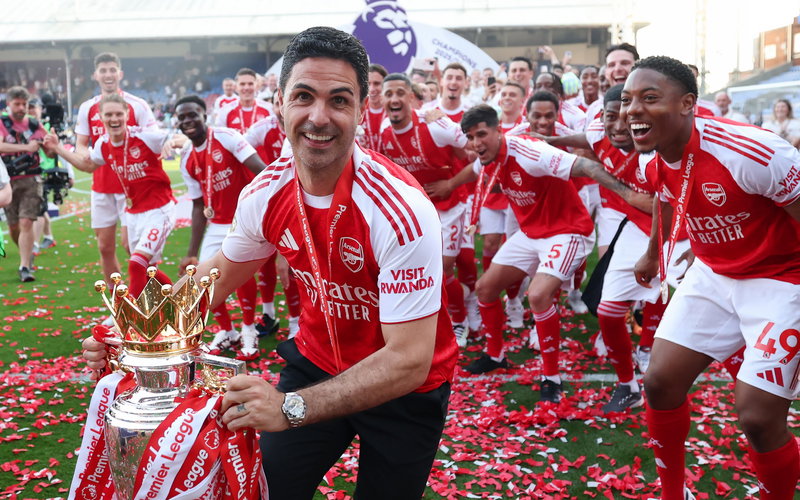
When Gary Neville and Ian Wright walked through the doors of London Colney for The Overlap Champions Special, the atmosphere they encountered was entirely unrecognisable from the fractured, cynical, and drifting institution of the late 2010s. The gleaming Premier League trophy sitting on the table was not just a symbol of sporting success; it was visual proof of a completed architectural project. For over two decades, Arsenal Football Club had been trapped in a profound identity crisis, bogged down by the heavy legacy of the late Arsène Wenger era, burdened by boardroom paralysis, and poisoned by what Josh Kroenke candidly termed the “banter years”. To look at Arsenal now—standing at the absolute apex of English football with a historic Premier League title secured and a UEFA Champions League final in Budapest just days away—is to witness a triumph of total systemic design.
The mainstream football media frequently oversimplifies this journey, reducing it to a romantic tale of blind patience, suggesting that Arsenal merely “trusted a process” until individual components randomly clicked into place. The reality is far more ruthless, calculated, and fascinating. Arsenal’s resurrection is the result of a total, uncompromising institutional overhaul. By examining the candid testimonies of Mikel Arteta, Josh Kroenke, and Richard Garlick, we can chart the exact mechanics of how a sporting giant was systematically dismantled, re-engineered, and woken from its slumber. It is a narrative that proves tactical genius on the pitch is entirely useless without absolute harmony and structural clarity off it.
To truly appreciate the weight of the silver lifted in May 2026, one must accurately measure the depth of the psychological trauma embedded in the fan base over the preceding decade. The old Emirates Stadium atmosphere had become a case study in athletic and cultural alienation. It was a sterile bowl defined by a toxic, symbiotic relationship between on-pitch stagnation and off-pitch exploitation. The matchday experience was frequently hijacked by the loud, reactionary economies of fan-led digital platforms, which monetised frustration, magnified internal rifts, and transformed structural club failures into viral micro-dramas. The stadium had become a colosseum of cynicism, characterised by the visceral booing of the club’s own players—most notably the infamous Granit Xhaka flash point in October 2019—and an overwhelming sense of entitlement that lacked any grounding in contemporary sporting reality. The fan base was completely fractured, viewing the team not as an extension of community identity, but as an overvalued, under performing corporate product.
The transformation witnessed during this title-winning campaign represents a complete paradigm shift. The modern Emirates Stadium is no longer a theatre of anxiety; it is an intimidating, unified, bouncing fortress fuelled by a shared sense of identity and collective struggle. The structural disconnect has been entirely repaired. Fans no longer turn up to the ground expecting to be passively entertained by isolated bits of individual luxury; they arrive to actively participate in an aggressive, high-energy collective movement. This emotional release is the direct result of a support base that has been made to feel part of the building process. The journey through the near-misses of the last two seasons did not break the fan base; it forged a resilience that matches the squad on the pitch. When Ashburton Army-led choruses roll down from the stands, it is clear that the crowd is no longer a group of detached consumers. They are the emotional engine of an elite sporting institution that has successfully traded toxic cynicism for absolute harmony, validating the club’s ancient maxim: Victoria Concordia Crescit—Victory Through Harmony.
Section 1: The cultural excavation & the “Ugly picture”
To understand the height of Arsenal’s current success, one must first accurately measure the depth of the valley Mikel Arteta inherited when he signed his contract in December 2019. Modern football management usually views a new appointment through a purely operational lens: fix the pressing trigger, optimise the standard attacking shape, alter the low-block spacing, and win the next match day. Yet, when Arteta walked through the doors of the training ground, he realised the rot was not tactical; it was existential. Arteta revealed to The Overlap that he immediately initiated a profound, sweeping internal audit to gauge the psychological pulse of the entire club. The feedback from ordinary staff members across the commercial, medical, grounds keeping, and media departments was staggering: “I did a very profound exercise to try to understand that is actually to understand deeply how people feels about working in the organisation, and I wasn’t happy and I wasn’t impressed at all about the way they describe it. So I put my hands on that.”
The club had effectively lost its soul. The environment inside London Colney was defensive, fragmented, and paralysed by a fear of failure, with staff members feeling entirely disconnected from the multi-millionaire players training just meters away. Arteta’s primary task was an aggressive, structural excavation of the club’s workplace culture before he could even dream of coaching a passing sequence. This required an uncompromising enforcement of his famous “non-negotiables”—a strategy that required being fundamentally harsh with high-earning, toxic assets who refused to submit to the collective cause.
“We agree as a team that there are certain behaviours that we expect and we want to promote,” Arteta explained to Gary Neville. “If somebody doesn’t do it… it cannot continue to be part of that… We can put the best beautiful words here around the walls but they mean nothing if they are not backed by everyday action.”
The defining testament to Arteta’s structural authority remains the ruthless execution of his cultural purge between 2020 and 2022. In the modern hyper-capitalist football economy, player power almost always trumps managerial philosophy. Yet, when confronted with deeply entrenched, highly paid, and culturally toxic assets, Arteta chose to fundamentally challenge the status quo. The high-profile exiles and contract terminations of Mesut Özil, Pierre-Emerick Aubameyang, and Mattéo Guendouzi were not merely disciplinary measures; they were high-stakes corporate statements of intent. Arteta recognised that you cannot build an elite high-performance environment on top of a compromised foundation. In the case of Aubameyang, stripping the captaincy from a reigning golden-boot winner just months after a massive contract renewal was viewed by mainstream pundits as managerial suicide. The media narrative was fiercely critical, weaponizing consecutive eighth-place finishes to paint Arteta as an uncompromising, inexperienced ideologue who was destroying the club’s balance sheet to satisfy his own ego.
The financial cost of these decisions was immense. Shifting these players required Arsenal to actively absorb heavy losses, paying off multi-million-pound contracts simply to remove them from the premises. Yet, Arteta willingly absorbed this intense short-term reputation damage because he understood the long-term compounding value of workplace integrity. He chose competitive regression over cultural compromise. By refusing to bend his non-negotiables for star talent, he sent an unmistakable shock wave through the entire infrastructure of London Colney. When absolute authority is demonstrated so clearly at the top, it establishes an unshakeable standard for every academy graduate and incoming signing. This clinical purging laid the structural groundwork for the current dressing room—an environment completely stripped of individual egos, operating strictly as a collective family unit where the crest on the front of the shirt completely dictates the name on the back.
This cultural reset wasn’t confined to the squad; it extended directly to the stands. Arteta’s deliberate co-opting of Louis Dunford’s The Angel was a stroke of psychological and social engineering. Recognising the deep alienation caused by the 18-month COVID-19 stadium lockout, during which the club had to play behind closed doors with zero physical connection to its local community, he used music to build an emotional bridge. Arteta did not simply impose the song from above; he tested it systematically. He presented it to the players and the staff, and then brought Louis Dunford himself into the London Colney dressing room to tell the raw story of the song and what North London meant to him. By doing so, Arteta turned a simple pre-match anthem into an organic manifestation of community identity. The noise that subsequently stopped the vitriol and brought the fans back on board was not accidental; it was budgeted for, engineered, and executed to perfection.
This absolute cultural baseline is fiercely protected by a uniquely constructed, highly specialised backroom staff. Arteta outlined a brilliant four-tier philosophy regarding the engineering of an elite coaching ecosystem, stating that an effective backroom staff must possess: total selflessness, absolute ideological alignment, proactive firefighting capabilities, and the intellectual bravery to challenge tactical assumptions. The concept of backroom “firefighters” is particularly crucial in the context of a global super-club. A modern manager can easily see their cognitive energy drained by a relentless stream of minor crises, player anxieties, agent complaints, and corporate distractions. Arteta’s staff—comprising figures like Albert Stuivenberg, Carlos Cuesta, and Miguel Molina—acts as an elite defensive shield, resolving internal friction long before it ever reaches the manager’s desk, ensuring Arteta’s focus remains squarely on macro-strategy.
The ultimate manifestation of this hyper-specific, obsessive backroom culture is set-piece coach Nicolas Jover. Jover’s work at Arsenal has completely redefined set-plays from marginal gains into central tactical weapons, breaking Premier League records along the way. His methodology is rooted in a culture of obsessive repetition, meticulous video analysis, and an almost religious attention to detail regarding structural spacing, visual blocking lanes, and goalkeeper disruption. The media frequently chalks up Arsenal’s astonishing set-piece efficiency to simple physical height or individual delivery, entirely missing the hours of frustration, error correction, and psychological preparation that take place hidden away on the Colney training pitches. As the players noted during The Overlap special, Jover does not just design routines; he creates an environment where world-class players approach every corner and free-kick with complete humility and absolute tactical clarity. It is an engineering mindset that perfectly reflects Arteta’s broader vision: excellence is not an act, but a repetitive, daily habit.
Section 2: The evolution of the executive matrix
For nearly a quarter of a century, Arsenal Football Club operated under a complete autocracy. Arsène Wenger was the club’s manager, sporting director, chief scout, financial gatekeeper, and economic supervisor all wrapped into one towering figure. While this highly centralised structure birthed historic eras, its structural vulnerability was exposed the moment Wenger departed, leaving behind an executive vacuum that plunged the club into years of chaotic, committee-led decision-making and expensive recruitment blunders. The true turning point of the modern Arsenal project was the deliberate transition to what Josh Kroenke termed the “North American Model”. This framework decoupled the overwhelming day-to-day corporate and legal responsibilities from the pitch, splitting the institutional burden across a highly specialised, modern executive spine: a technical Head Coach (Arteta), a collaborative Sporting Director (Edu, followed by a unified recruitment apparatus), and an elite Chief Executive (Richard Garlick).
The genius of the “North American Model” implemented by the Kroenkes lies in its cold, structural insulation against the emotional volatility inherent to professional football. Traditional football clubs often fall victim to a systemic flaw: executive decisions are heavily dictated by the immediate results of the first team. A three-match losing streak routinely sparks boardroom panic, leading to reactionary managerial sackings and erratic, scattergun squad building to quieten an angry fan response. Arsenal’s modern three-pronged executive matrix completely decouples short-term emotional swings from long-term institutional goals. It establishes a system of corporate checks and balances that ensures tactical recruitment aligns perfectly with financial sustainability and long-term asset management.
When the team experiences a bump in the road, the executive tier doesn’t scramble to appease media pundits. Instead, the data-driven infrastructure remains fixed on the club’s wider commercial and sporting projections. Garlick ensures that commercial revenues are consistently maximised to feed back into the facility infrastructures, while the scouting network protects the long-term age profile of the squad. This structural insulation allows Arsenal to operate with the calm, calculated precision of a blue-chip corporation, executing a multi-year blueprint while rival organisations are trapped in a perpetual cycle of short-term crisis management.
There is no better case study for the real-world execution of this structural protection than the high-stakes goalkeeper transition during the 2023/24 campaign. The decision to demote Aaron Ramsdale—a highly popular English international who had just signed a long-term contract extension—in favour of David Raya was a move that went against conventional football wisdom. The media response was immediate and incredibly hostile, generating months of intense press conference pressure, manufactured controversies, and uncomfortable national debates regarding the validity of having “two number ones”. Arteta’s behind-the-scenes reflection on The Overlap exposes the exceptional health of Arsenal’s executive apparatus. Arteta was entirely convinced that to elevate the team’s build-up phase and defensive line to a world-class level, he required the specific, aggressive sweeping, cross-collection, and precise distribution profile of David Raya.
However, in a fractured club, a manager suggesting a move that would trigger a massive public relations storm would be immediately shut down by an anxious, self-preserving board. At Arsenal, the process was a masterclass in executive alignment. Edu did not blink; instead, he rigorously challenged Arteta’s conviction to ensure total clarity: “Mikel, are you 100% sure? … I know, Mikel. You’re going to expose yourself. If it goes wrong, the blame lands on you.” Once Arteta confirmed his absolute certainty, the sporting director immediately acted as a political shield, heading upstairs to convince the board, manage the executive fallout, and sanction the deal. This is the true definition of structural harmony: an environment where a manager is granted the safety to make highly unpopular, elite-level technical decisions because his sporting director and executive team are willing to absorb the external blast radius to protect the technical vision.
This framework ensures that Arsenal no longer makes decisions based on short-term panic or external noise. When Richard Garlick manages the financial, contract, and commercial growth, it frees Arteta to manage the human capital and elite tactical execution. The result is an executive machinery where every component understands its exact boundaries, resulting in what Garlick described as an organisation that is simultaneously winning off the field, winning on the field, winning with the supporters, and winning with our community. By separating the emotion of the matchday from the strategy of the boardroom, Arsenal have built an infrastructure that does not react to the football world; it dictates it.
Section 3: The Kroenke paradigm & financial capital
No structural model can function without financial backing, but more importantly, no model can survive without deep political capital from the ownership tier. The definitive turning point in the trajectory of modern Arsenal occurred in August 2018, when the Kroenke family assumed 100% sole ownership of the club by buying out Alisher Usmanov. Prior to this milestone, the bruising, public boardroom cold war between Stan Kroenke and minority shareholders had trapped the club in a state of financial conservation, risk aversion, and strategic paralysis. Total ownership unlocked the ability to make long-term, high-risk financial commitments without accountability to hostile minority board members.
Josh Kroenke’s reflections on The Overlap provided a rare, transparent look into the ownership’s shifting psychology during this transition. He identified the crushing 2019 Europa League final defeat to Chelsea in Baku as the precise moment of institutional clarity. Returning to the United States via a lonely transatlantic flight, Josh explicitly told his father that the club’s strategy of “straddling the fence”—trying to patch up an ageing, unmotivated squad with expensive, short-term veteran stopgaps while tentatively bleeding in youth—was fundamentally broken. They needed to make a brave, conscious decision to “take a step back to eventually go forward.”
To fully appreciate the Kroenke family’s backing of this project, one must examine the profound financial and competitive bravery required to intentionally take a step backward in the modern Premier League. Following that Baku defeat, the standard commercial response for a club in Arsenal’s position would have been to double down on expensive, short-term veteran acquisitions in a desperate attempt to force a quick return to Europe’s top table to safeguard immediate broadcast and commercial streams. Instead, the Kroenkes deliberately sanctioned a youth-centric recruitment drive that required immense corporate patience and the acceptance of immediate revenue losses. The signature manifestation of this long-term strategy was the £27 million acquisition of William Saliba.
Rather than integrating Saliba immediately into a fragile, under performing first team to justify the heavy expenditure to an impatient fan base, Arsenal chose to loan the teenage defender back to France for three consecutive seasons to systematically mature his game away from the Premier League pressure cooker. To spend a substantial chunk of a restricted transfer budget on an asset that would not yield on-pitch returns for thirty-six months requires an extraordinary level of institutional conviction. The Kroenkes chose to absorb the immediate financial hit of missing out on Champions League revenues because they believed in the long-term compounding interest of building an elite, young core. They sacrificed the immediate present to guarantee ownership of the future.
This boardroom patience and financial restructuring laid the foundation for the ultimate statement of Arsenal’s new financial power: the £105 million acquisition of Declan Rice from West Ham United. Arteta noted that a club of Arsenal’s international stature must make seismic statements to shift external perceptions and establish dominance. If the post-Baku strategy was about clearing out the foundation and accepting short-term pain, the acquisition of Rice completely shattered the old narrative that Arsenal was an economic stepping-stone—an institution that developed world-class talent only to inevitably sell it to wealthier domestic or European rivals.
Josh Kroenke’s corporate insight into the signing details the rigorous criteria behind an investment of this historic scale. For a price tag that exceeded nine figures, the ownership group did not merely look at tactical metrics, interception rates, or physical output on the pitch. They required a “plug-and-play” elite footballer who also brought a transformative, world-class leadership profile off the field. The club needed an individual whose character, work ethic, and humility could seamlessly match and reinforce the workplace culture Arteta had spent four years building. Rice choosing Arsenal over hyper-wealthy, treble-winning rivals like Manchester City proved that the project’s internal health was now its greatest recruitment tool. Players were no longer joining Arsenal for a lucrative retirement salary; they were choosing it because they wanted to be part of an elite, historical movement.
Conclusion: Awakening the giant
As the interview at London Colney drew to a close, Chief Executive Richard Garlick uttered a poignant phrase that will resonate with every single Arsenal supporter across the globe: “We’ve managed to unlock that potential. We’ve woken the giant up… the beast, whatever you want to call it.” The victory parade through North London is not a final destination; it is merely a launchpad. Because the foundation of this club has been constructed so meticulously, with every executive pillar fastened securely to the next, the future looks terrifyingly bright for the rest of Europe.
The club’s modern dynamics are perfectly illustrated by the integration of its youngest assets. As senior players noted, the environment at London Colney is uniquely designed to nurture elite academy talents like Ethan Nwaneri and Miles Lewis-Skelly. Rather than throwing these teenagers into the spotlight during moments of structural chaos, they are introduced into a stable, humming system backed by senior leadership and tactical clarity. The veteran core ensures these youngsters are protected, listened to, and given the freedom to play with a smile, ensuring the academy pipeline remains a sustainable competitive advantage.
Furthermore, the executive team is already pivoting from domestic celebration to long-term infrastructure evolution, using best practices from the Kroenkes’ state-of-the-art SoFi Stadium project in Los Angeles to design future upgrades for the Emirates Stadium as it hits its 20-year anniversary. They are actively analysing options to ensure Arsenal’s home remains a world-class commercial powerhouse capable of matching and exceeding any modern stadium infrastructure in the world, reinvesting every penny of that revenue directly back into the playing squad.
Arsenal did not stumble into this Premier League title through a stroke of luck, a momentary dip from their rivals, or an individual moment of unrepeatable genius. They built it. From the painful, exhausting cultural purging of 2020 to the boardroom bravery of the post-Baku reset, every single brick was laid with absolute intentionality. As the squad prepares to step onto the pitch in Budapest for the UEFA Champions League final, they do so backed by an institution operating in perfect, golden harmony. The giant is awake, its infrastructure is flawless, and it has absolutely no intention of going back to sleep.