

We are standing on the precipice of an architectural collapse within the British football media infrastructure. As the final weeks of the 2025/26 campaign reach their crescendo, Arsenal sit at the apex of the domestic game with only Burnley and Crystal Palace standing between them and the Premier League crown. Simultaneously, a historic UEFA Champions League final in Budapest against Paris Saint-Germain awaits on the horizon. For the red half of North London, it is the potential culmination of an agonising, meticulous, and fiercely contested evolutionary cycle under Mikel Arteta. For the broader footballing establishment, however, it represents something altogether more terrifying: the day their favourite economic model of mockery runs completely out of road.
For over half a decade, a sprawling cottage industry has been constructed entirely upon the foundations of doubting, micro-analysing, and subverting the reality of Arsenal’s progression. From the moment Arteta walked through the doors of London Colney in late 2019, the goalposts have not merely been shifted; they have been uprooted, loaded onto the back of a flatbed truck, and driven across continents. If Arsenal go on to secure the Premier League title, the Champions League, or an unprecedented European Double, the ensuing response from mainstream pundits, toxic fan-channels, and online influences will not be a collective olive branch of apologies. Instead, we are about to witness an exhibition in intellectual gymnastics and industrial-grade coping mechanisms that will redefine sports journalism entirely.
1. The Punditocracy: The corporate pivot and “The Cliché lifeline”
The traditional broadcast corridors of Sky Sports, TNT Sports, and the BBC are populated largely by a golden generation of ex-players whose entire analytical framework was forged during an era when Arsenal were comfortably designated as “soft”. For years, the likes of Gary Neville, Roy Keane, and Rio Ferdinand have fallen back on a reliable lexicon of platitudes when discussing the Gunners. They lacked “leadership,” they lacked “characters,” they were “fragile,” and they “over-celebrated”. When a team systematically dismantles those narratives by building the most robust defensive unit in European football, the punditocracy cannot ignore the trophies, but they can and will seek structural excuses to diminish the achievement.
The “Manchester City Collapse” narrative
Should Arsenal lift the Premier League trophy, watch how rapidly the analytical gaze shifts away from the tactical mastery of Arteta’s out-of-possession block and onto the supposed fatigue of Manchester City. The corporate pivot will dictate that Arsenal did not win this league; rather, Manchester City simply vacated the throne. Pundits will point to the emotional and physical toll of City’s multi-year dominance, the off-field distractions of their ongoing legal battles with the Premier League regarding the 115 financial charges, and the natural regression of Pep Guardiola’s squad.
“Expect a sombre, state-of-the-nation monologue from Gary Neville, delivered with a furrowed brow, explaining how a historic Arsenal title is actually a symptom of a transitioning Premier League rather than the coronation of an elite footballing powerhouse.”
The narrative will be carefully packaged to suggest that Arsenal merely acted as a competent placeholder in a season where the true giants of the modern era fell asleep at the wheel. By framing the triumph as a default victory, the establishment neatly avoids having to admit that Arteta’s “Process” has yielded a team superior to their preferred protagonists.
The “Path of Least Resistance” in Europe
In the continental theatre, the narrative construction is already well underway. Outlets across the media landscape have already begun tinkering with the revisionist history of the 2025/26 UEFA Champions League. Despite Arsenal navigating the gruelling new league phase with flawless discipline—finishing in the top tier to completely bypass the hazardous knockout playoff round the narrative will be spun that Arsenal enjoyed an “easy” path to Budapest.
If the Gunners defeat Paris Saint-Germain to lift the big-eared trophy, the pundits will loudly declare that Arsenal managed to avoid the traditional heavyweights over two legs. They will conveniently overlook the reality that European football is an exercise in structural endurance, and that Arteta’s side earned their favourable seeding through sheer merit. The media will look at a Champions League trophy and see a bracket fluke; Arsenal fans will see the definitive validation of an elite European squad.
2. The influencer economy: Pure copium and financial accounting
While the mainstream broadcasters will mask their bitterness behind corporate professionalism, the digital wild west of football media comprising YouTube fan-channels, TikTok tacticians, and Twitter contrarians will descend into pure, unadulterated hysteria. This sector of the media operates on a currency of outrage and engagement. For Manchester United, Chelsea, or Tottenham influencers, an Arsenal failure is worth thousands of pounds in views and clicks. An Arsenal double threatens their very livelihood. Therefore, their defensive mechanisms must be aggressive, unrelenting, and completely detached from reality.
The “Dark Arts” and the Anti-Football smear
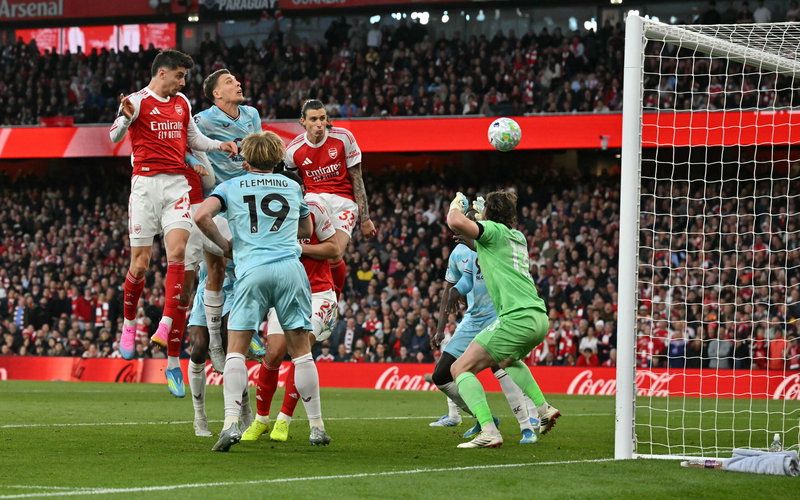
We have already caught a glimpse of this line of attack during the current campaign. Arsenal’s absolute dominance at defensive set-pieces, orchestrated by Nicolas Jover, alongside their willingness to manage games with supreme pragmatism, will be weaponised. The internet will be flooded with compilations of Gabriel Magalhães subtly blocking an opposition goalkeeper, or William Saliba executing a flawless tactical foul on the halfway line.
Influencers will dub Arteta’s side as “Tony Pulis with a Spanish accent” or “The Premium Stoke City”. They will argue that Arsenal have “ruined football” with their physical, structured, and risk-averse style. It is a delicious irony: for a decade, Arsenal were mocked for being too pretty, too naive, and too easily bullied. Now that they are the bullies, the digital space will weep for the death of aesthetic football, unable to reconcile the fact that Arteta has fused technical brilliance with cold, mechanical ruthlessness.
| Era | Media Consensus Narrative |
| 2016 Media Consensus |
“Too soft, too predictable, obsessed with walking the ball into the net. Lack the steel to win an honest league title.”
|
| 2026 Anticipated Consensus |
“Too rigid, overly reliant on set-pieces, kill games through defensive control. A boring triumph of structural engineering.”
|
The sudden apparition of the balance sheet
The moment the confetti settles, rival content creators will suddenly transform into chartered accountants. They will tally up the gross expenditure of the club since 2020, flashing figures of Declan Rice, Kai Havertz, and Viktor Gyökeres across screens with flashing red text. “They have spent nearly £700 million!” they will scream into their ring-lights. “They should be winning the double!”
This argument relies entirely on the collective amnesia of the audience. It completely ignores the fact that Chelsea, Manchester United, and even mid-table clubs have spent comparable, if not vastly superior, sums over the exact same period only to construct disjointed, dysfunctional squads. The media will attempt to rebrand a triumph of elite coaching, recruitment, and cultural overhaul as a simple, uninspired exercise in buying the league.
3. The tactical hipsters: “It was simple, not special”
The self-appointed custodians of the tactical avant-garde the Substack writers and Twitter diagram-drawers who thrive on over-complicating the simple game will face their own existential crisis. These analysts love to celebrate the eccentric, the unorthodox, and the experimental. Because Arteta’s 4-3-3 turning into a fluid 3-2-4-1 hybrid is so intensely disciplined, symmetrical, and repeatable, the tactical elitists will attempt to devalue it by categorising it as “derivative” rather than “innovative”.
The Guardiola clone accusation
The prevailing thesis in these intellectual circles will be that Arteta has brought nothing genuinely original to the sport. They will write exhaustive essays claiming that Arsenal’s success is merely a perfectly executed carbon copy of the Manchester City blueprint. They will argue that it represents a triumph of corporate execution rather than romantic, individual footballing genius.
Every tactical nuance that belongs uniquely to Arteta the specific pressing triggers of Martin Ødegaard, the unique left-sided rotations involving Declan Rice, and the defensive flexibility of Ben White—will be dismissed as basic iterations of principles established in Manchester. To acknowledge Arteta as a genuine innovator would require these analysts to abandon their long-held preference for coaches who prioritise philosophical purity over trophies.
The micro-analysis of luck and VAR
If Arsenal secure the title or the Champions League by marginal distances, expect the tactical hipsters to produce 50-tweet threads evaluating every single VAR decision, deflected shot, or opposition injury across the 38-game season. They will use expected goals (xG) models and convoluted refereeing timelines to mathematically “prove” that Arsenal were the beneficiaries of an unprecedented statistical anomaly of good fortune. A refereeing decision praised by Arteta as “brave but consistent” will be immortalised as proof of an institutional bias, turning a historic sporting achievement into a grand conspiracy theory.
4. The disparity in patience: The Amorim and Post-Arteta myth
To fully understand why the media will struggle so immensely with an Arsenal triumph, one must look at how the press handles other modern managers. There is a distinct disparity in how media narratives are manufactured regarding “time” and “patience”. Within modern football punditry, Mikel Arteta’s early struggles finishing 8th in back-to-back seasons while purging a toxic, bloated dressing room have been twisted into a universal shield used to protect every failing project across the country.
Whenever a new manager takes over a big club and undergoes a disastrous opening year, the immediate cry from the studio is: “Look at Arteta! You have to trust the process!” We see it constantly when pundits discuss managers who have reached their first 50 games in charge or concluded their first full year with minimal identity and zero silverware. Yet, this comparison is entirely flawed, and the media intentionally ignores the vast differences in political and financial capital.
“Arteta did not simply endure bad results; he actively tore down a broken club culture, taking massive personal and political hits by alienating high-earning superstars to establish a non-negotiable elite environment. He won an FA Cup within months of arrival despite structural chaos.”
When the media compares other managers to Arteta, they are comparing apples to engines. Other coaches are given a pass for mediocre 50-game stints under the guise of an “Arteta rebuild,” while being shielded from the intense scrutiny Arteta faced daily. If Arsenal win the ultimate prizes, this convenient media shield will shatter. Pundits will no longer be able to use Arteta’s name as a generic excuse for multi-million pound failure elsewhere, because the standard of what a “Process” must actually achieve will have been set at the absolute maximum level.
5. The Arsenal Mania perspective: The ultimate vindication
For the global Arsenal fan base, and specifically those who have lived through the digital trenches of the club’s modern history, an elite trophy delivery will provide a level of vindication that cannot be properly measured in words. This is the fan base that was told that extending Arteta’s contract was a sign of a club content with mediocrity. This is the fan base that was mocked when they celebrated building blocks, clean sheets, and tactical growth.
An Arsenal triumph will be the definitive proof that the path chosen by the club unwavering internal alignment, ruthless cultural execution, and absolute trust between the executive board, the manager, and the terrace was correct. It will stand as a monument to the rejection of the modern footballing urge to sack a manager at the first sign of an April wobble. While the outside world constructs its elaborate theories of luck, anti-football, and financial advantages, the community within North London will know the truth: this was a football club that looked into the abyss of institutional decay, designed a meticulous blueprint for resurrection, and executed it flawlessly.
Conclusion: The glorious sullen surrender
Ultimately, how the media handles an Arsenal Premier League or Champions League triumph is entirely irrelevant to the historical record. You cannot print an info graphic detailing “expected luck” onto a gold Premier League sleeve. You cannot engrave the phrase “Guardiola Clone” onto the silver base of the European Cup. Trophies possess a unique, magical quality: they force a reluctant, sullen surrender from your detractors.
The parade through the streets of Islington will be an explosion of sound, colour, and pure emotion, celebrating a team that refused to capitulate to the narratives designed for them. And as the open-top buses make their way past the thousands of red-and-white shirts, the collective grinding of teeth across television studios, editing suites, and rival fan-channels will provide the most beautiful, harmonious backing track imaginable. The establishment will move the goalposts one last time, but by then, Arsenal will have already won the game.
Thanks for a good writeup. They’ll surely try to frame Arsenal winning to suit their tired narratives. All ragebait.