

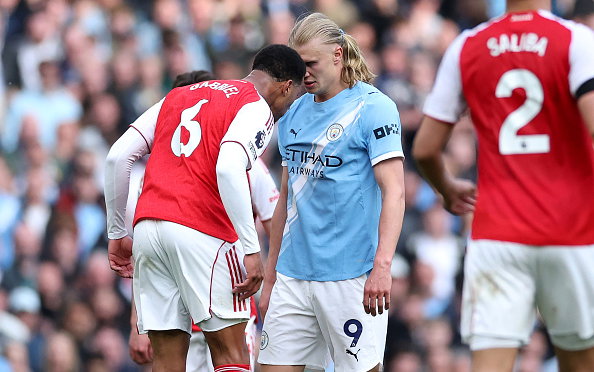
The 24-hour cooling-off period following a defeat at the Etihad Stadium usually brings clarity, but today it only brings a cold, hard realisation: Arsenal are no longer fighting Manchester City; they are fighting their own inability to seize the moment. The 2-1 scoreline is a familiar ghost. It is the sound of a door being left ajar for a rival that doesn’t just walk through openings—they dismantle the entire frame.
While Arsenal remains top with 70 points, City’s game in hand makes the Gunners’ three-point lead feel like a house of cards in a Manchester gale. As the sun sets on another high-stakes weekend, we must look deeper than the scoreline. We must look at the structural, psychological, and clinical failures that turned a potential coronation into a desperate fight for survival.
I. The anatomy of a defeat: The “guilt-edged” failures
To understand why this loss feels different from the drubbings of years past, we have to look at the moments that will keep Mikel Arteta awake until the Newcastle kick-off. This wasn’t a game where Arsenal were outclassed; it was a game where they were non clinical. The “two boxes” narrative that Arteta preached in his post-match presser was personified by two specific, guilt-edged openings that could have rewritten the history of the 2025/26 season.
The Havertz block (60th Minute): With the game locked at 1-1, Martin Ødegaard carved open the City backline with a trademark threaded pass. Kai Havertz, having already scored a somewhat fortuitous equaliser via a Gianluigi Donnarumma error, had the goal at his mercy. Instead of the “ice-cold” finish required in a title decider, his shot was well-read by the Italian keeper. In a match of this magnitude, against this City machine, you simply do not get three lives.
The Eze Post & The Goal-Line Scramble (63rd Minute): Minutes later, Eberechi Eze—the man brought in for a king’s ransom specifically to provide that final-third magic—hit a low curler that beat Donnarumma but rattled the inside of the post. The ball agonisingly rolled across the face of the goal. In the ensuing scramble, Gabriel Martinelli and Ødegaard were crowded out. Within 120 seconds, Erling Haaland pounced at the other end.
That is the media narrative in a nutshell: Arsenal provide the “almosts,” while City provide the “always.” These misses didn’t just cost points; they reinforced the global footballing perception that Arsenal lacks the clinical edge necessary to dethrone a dynasty. When you hit the woodwork twice and miss a one-on-one at the Etihad, you aren’t “unlucky”—you are unprepared for the psychological weight of the gold.
II. The squad depth Illusion: When the “second string” stalls
For the past two years, the narrative surrounding Arsenal has been their “perfectly assembled squad.” On paper, the depth is there. We see names like Gabriel Martinelli, Noni Madueke, and Gabriel Jesus on the bench and assume the floor is high. However, the Etihad exposed a brewing crisis: while the starting XI is world-class, the “second string” players simply aren’t good enough to sustain a title charge under the highest pressure.
Mikel Arteta has spent hundreds of millions to reach this point, yet when the game hung in the balance, the bench offered no solutions. This brings us to a harsh truth regarding the disparity in quality.
-
The Drop-Off: When Martinelli came on for Madueke, the drop-off in defensive discipline and tactical awareness was visible. His heavy touch while defending a corner nearly gifted Haaland a goal earlier than expected. There is a sense that while our “B-team” is better than most, they lack the “match-winner” mentality needed when the stars are leg-heavy.
-
The “Aura” Gap: While City can bring on the likes of Phil Foden or Savinho—players who would walk into any other starting XI in the world—Arsenal’s substitutes feel like protective measures rather than offensive weapons.
-
The Burden of Responsibility: Patrick Vieira noted recently that it is time to stop questioning Arteta’s tactics and start questioning the players’ individual demand. If the “Process” provides you with three clear-cut chances at the Etihad, the manager has done his job. The failure lies in a squad that lacks the “coldness” of a champion.
We have to be honest: if Ødegaard or Rice are having an off day, the drop-off to the replacement level is a chasm, not a step. This lack of quality in the auxiliary parts of the engine is why Arsenal are wobbling. They have lost four of their last six games in all competitions—a run that includes a Carabao Cup final loss and an FA Cup exit to Southampton. This isn’t a blip; it’s a structural fatigue.
III. The confidence tax: The ghost of games past
Confidence in football is a fragile currency, and Arsenal’s account is currently overdrawn. This loss to City doesn’t exist in a vacuum; it follows a pattern of dropping points in games that should have been “bankers.”
From the 2-2 draw with Liverpool in February where they led twice, to the recent back-to-back league losses, the squad is bleeding belief. Every time a shot hits the post instead of the net, the “bottling” narrative grows louder in the players’ ears. Arteta’s biggest challenge now isn’t the tactics board; it’s the therapist’s chair.
When you lose a game you dominated, it creates a “Confidence Tax.” Players begin to second-guess their touches. They start to look for the pass rather than taking the shot. We saw it in the final ten minutes at the Etihad—players who are usually brave on the ball were playing it safe, terrified of being the one to make the mistake that ends the title dream.
IV. The media disparity: Arteta vs. The narrative
One of the most fascinating aspects of your upcoming article for Arsenal Mania is the disparity in how Arteta is treated by the media compared to his peers. Take Ruben Amorim, for example. Amorim’s recent stint at Manchester United was marred by a lack of political capital and structural support, leading to his exit in January 2026.
Critics often compare new managers to Arteta’s “first year,” but they forget the unique conditions Arteta enjoyed:
-
Political Capital: Arteta was given the power to “clear the floor,” removing high-earning stars to reset the culture.
-
The Patience Gap: Other managers are sacked after 50 games if results don’t follow. Arteta was given 150.
-
The Standard Shift: Because Arteta survived the storm, the media now treats any defeat as a catastrophic failure of the “Process.”
The footballing world—from Madrid to Rio—views Arsenal as the “great entertainers” who lack the “great resolve.” If Arsenal finishes second again, the narrative won’t be about how well they did to compete with City’s billions; it will be about the failure to convert progress into silverware. The “Trust the Process” slogan has reached its expiry date. It is now “Deliver or Depart.”
V. The run-In: five finals for redemption
The schedule ahead is unforgiving. It starts with Newcastle United at the Emirates this Saturday. Newcastle, chasing their own European dream, will not be a “get right” game. Following that, Arsenal face Fulham, West Ham, Burnley, and a season finale at Crystal Palace.
The Equation:
-
Arsenal: 33 Games, 70 Points.
-
Man City: 32 Games, 67 Points (Playing Burnley Wednesday).
To win this league, Arsenal likely need 15 points from 15. Anything less, and they are relying on a City stumble that history tells us rarely comes in the spring.
VI. Final Thoughts for Arsenal Mania
As I pen this piece, the message to the fans must be clear: the performance at the Etihad was a “championship-level” display with “relegation-level” finishing.
Arsenal got to this point by playing the most beautiful football in the country, but they are losing their grip on the title because they haven’t learned how to be ugly. The “second string” of the squad has failed to provide the safety net required for a 38-game marathon.
The stage was set for a big performance. The performance was there. The “killer” was not. If this group wants to change the media narrative and finally move out of Pep Guardiola’s shadow, they have five games to prove that “The Process” wasn’t just a fancy word for “Almost.”
Follow-up Question for the Community: Is the lack of a traditional, physical ‘Plan B’ striker the missing link that would have converted those woodwork hits into goals, or is the issue deeper—a mental glass ceiling that this squad simply hasn’t broken through yet?