

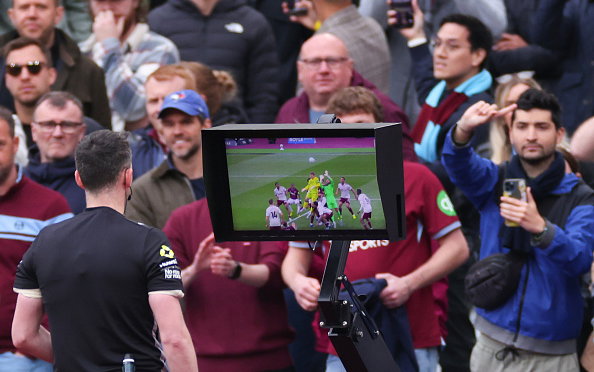
In the hyper-saturated world of English football media, objectivity is often sacrificed at the altar of “engagement.” For Arsenal Football Club, this has manifested in a systemic and identifiable bias that goes beyond typical rivalry. From the terraces of the Emirates to the away ends across the country, there is a burgeoning consensus: Arsenal are being held to a regulatory and narrative standard that simply does not apply to their peers.
Whether it is the selective application of officiating “law changes,” the framing of tactical efficiency as “dark arts,” or the deafening silence regarding Manchester City’s 115 financial charges, the evidence suggests that the “hidden agenda” is no longer a conspiracy it is a documented reality.
1. The PGMOL paradox: Rule changes for one
The most visceral evidence of an agenda appeared during the early stages of the 2024/25 campaign. Football fans are used to PGMOL “crackdowns,” but the introduction of stricter officiating regarding “delaying the restart” felt uniquely tailored to disrupt Arsenal’s momentum.
The Rice and Trossard precedent
The dismissals of Declan Rice against Brighton and Leandro Trossard against Manchester City were seismic. Rice was shown a second yellow for a nudge of the ball that occurred while the ball was still in motion. Trossard’s second yellow followed a whistle that blew a mere fraction of a second before his strike.
The media’s immediate response was to hide behind the “letter of the law.” Pundits insisted that “by the book,” the referee had no choice. However, the subsequent weeks provided a stark counter-argument. Data collected from the fixtures following the Trossard incident showed dozens of instances where players from other clubs kicked the ball away or blocked free-kicks with zero repercussions. When Jeremy Doku or Erling Haaland engaged in similar behaviour, it was described as “competitive edge.” For Arsenal, the “new ruling” was effectively a ghost; it materialised to punish them and then vanished from the league’s consciousness.
2. The 115-charge silence: A tale of two governance narratives
Perhaps the most egregious example of media bias is the disparity between how Arsenal’s “Process” is scrutinised and how Manchester City’s “Machine” is protected.
The scrutiny of “The Process”
Mikel Arteta’s rebuild has been under the microscope since day one. Every pound spent—whether on Ben White, Aaron Ramsdale, or Kai Havertz was initially framed as a “panic buy.” The media narrative was one of constant scepticism, with many waiting for the “wheels to fall off.” Even as Arsenal became the primary challengers to the City hegemony, the narrative shifted from “they aren’t good enough” to “they are bottle jobs.”
The protection of the 115
Contrast this with Manchester City. Despite facing 115 charges for alleged financial irregularities charges that strike at the heart of sporting integrity the media coverage remains curiously sanitised. There is no daily “label” attached to City’s successes. We do not hear pundits constantly questioning the “validity” of their trophies in the same breath as their tactical brilliance. The media are happy to discuss Arsenal’s “dark arts” for hours, yet the potential institutional fraud of a state-backed club is treated as a minor legal technicality.
3. The “Celebration Police” and the policing of joy
One of the most bizarre narratives unique to Arsenal is the criticism of how the team and fans celebrate. The “Celebration Police,” led by figures like Richard Keys and Jamie Carragher, have spent years attempting to suck the joy out of North London.
When Mikel Arteta celebrated a last-minute winner by running down the touchline, he was called “undisciplined” and “disrespectful.” When Martin Ødegaard took a photo of the club photographer after a win over Liverpool, it was labelled “immature.” Yet, when Jurgen Klopp engaged in similar antics, it was “passion.” When Pep Guardiola berated his own players on the pitch for the cameras, it was “genius at work.” This social engineering seeks to make Arsenal fans feel embarrassed for their success, creating a narrative of “arrogance” that isn’t backed by the facts.
4. The “Dark Arts” and tactical Gas lighting
In football, innovation is usually celebrated. When Tony Pulis used long throws, it was “effective.” When Liverpool used a throw-in coach, it was “revolutionary.” However, when Arsenal became the most dominant set-piece team in Europe under Nicolas Jover, the media narrative turned sour.
Rather than praising the technical precision of Bukayo Saka’s delivery or Gabriel Magalhães’ movement, the media labelled Arsenal’s corners as “anti-football.” Terms like “blocking” and “dark arts” became the default. By branding efficiency as a “dark art,” the media creates a psychological environment where referees are primed to look for fouls against Arsenal. It is a lazy bias that suggests Arsenal are “cheating” because they have found a tactical edge rivals are too slow to replicate.
5. The Bukayo Saka protection disparity
The persistent fouling of Bukayo Saka is a crucial factual point regarding player safety. Saka remains one of the most fouled players in Europe, yet the ratio of yellow cards shown to his markers is significantly lower than that of Jack Grealish or Phil Foden.
While stars at other clubs are “protected,” Saka is often told to “toughen up” or accused of “going down too easily.” This subconscious bias denies Arsenal players the protection afforded to their “media-darling” rivals, often leading to injuries that are then used by the same media to mock Arsenal’s “lack of squad depth.”
6. The Ruben Amorim comparison: A flawed target
A recent trend has seen the media comparing new managers, such as Ruben Amorim, to Mikel Arteta to diminish the latter’s achievements. This comparison is fundamentally flawed.
Arteta inherited a “broken” club with a toxic culture and a bloated, ageing squad. He had to gut the institution and rebuild it from the foundation up. Managers like Amorim or Arne Slot have stepped into far more stable structures. By ignoring the disparity in “political capital” and the sheer scale of the rebuild, the media engages in tactical gas lighting to suggest that Arteta’s “Process” was simple or that he was “given too much time.” In reality, Arteta earned that time through early successes like the FA Cup—a fact often conveniently forgotten.
7. The London Stadium incident (May 10, 2026)
On Sunday, May 10, 2026, at the London Stadium, we saw a microcosm of this bias. Arsenal secured a vital 1-0 win through a Leandro Trossard goal, but the post-match discussion was dominated by a disallowed Callum Wilson goal and the conduct of Arsenal’s away support.
Despite the VAR correctly identifying a foul on David Raya, the media focused on the “controversy,” attempting to paint Arsenal as lucky. Furthermore, the narrative shifted to the “provocative” nature of Arsenal fans celebrating their win, ignoring the hostility they faced from the home sections. This is the “lazy” bias in action: shifting the focus from a professional, disciplined performance to a negative narrative about the fans.
8. The economics of “Arsenal Hate”
Why does this bias persist? The answer is financial. Arsenal has one of the largest and most digitally active fan bases in the world. Negative news about Arsenal drives “hate-clicks” from rivals and “outrage-clicks” from supporters.
Broadcasters like Sky Sports and TNT know that a 45-minute debate on a Declan Rice yellow card will generate more revenue than a deep dive into the 115 charges against City. Hating Arsenal is profitable. This financial incentive has created a self-fulfilling prophecy where the club is always cast as the villain, regardless of the facts on the pitch.
9. Historical memory: The moving goalposts
The media narrative has shifted from “Boring, Boring Arsenal” to “Soft/Frail Arsenal” to now “Cheating/Dark Arts Arsenal.” This proves that the goalposts are constantly moving. When Arsenal were “soft,” they were mocked; now that they are “physically dominant,” they are “bullies.” The common denominator is not Arsenal’s behaviour, but the media’s desire to find a stick with which to beat the club.
10. Conclusion: The resilience of the North London identity
Despite the “anti-media bias,” the “lazy narratives,” and the “institutional inconsistencies,” Arsenal continue to progress. The “hidden agenda” has not broken the club; it has galvanised it.
The reality is that Arsenal are held to a higher standard because they represent a threat to the established order. They have built a title-contending team through a “clean” model of recruitment and coaching. This threat is exactly why the media and governing bodies are so willing to frame every action in a negative light.
As the 2025/26 season nears its conclusion, with Arsenal sitting 2 points clear at the top and with 2 games remaining to be crowned champions , the facts remain clear: the bias is real. But as the fans know, when you have to play against twelve men every week—the eleven on the pitch and the narrative in the press—victory tastes all the sweeter.
Excellent article. There are plenty of parallels in the wider world where someone/some people are targeted as objects of hate and then this morphs into finding reasons for the hate. The only team that get “same old….always cheating” is Arsenal; this is a travesty and is often sung by opposing fans the first time the referee blows for a foul in our favour because one of our players has got kicked. The message is clear Arsenal are cheats and therefore they must be cheating even when all the evidence points against it.
I call it jealousy