

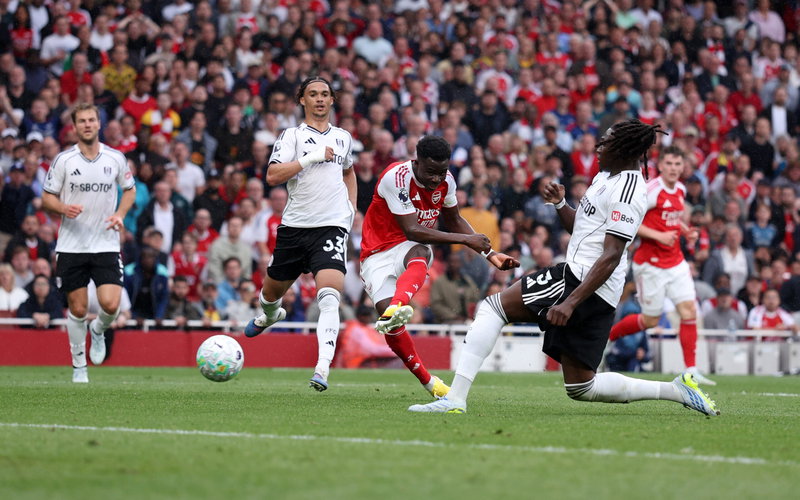
The Emirates Stadium has witnessed its fair share of tactical chess matches this season, but Saturday afternoon felt less like a grand master duel and more like a blitzkrieg. In a performance defined by flair, fearlessness, and a long-awaited sense of freedom, Arsenal dismantled Fulham 3-0, restoring a six-point cushion at the summit of the Premier League and sending a chilling message to Manchester City.
For weeks, a section of the North Bank has voiced a quiet anxiety. Despite the results, there was a lingering sense that the Gunners were playing with the handbrake on—lacking the predatory urgency that defined their early-season form. Against Marco Silva’s men, however, the handbrake wasn’t just released; it was ripped out entirely.
A start with intent
From the first whistle, the tempo was set. Arsenal’s press was suffocating, forcing Fulham into panicked clearances and unforced errors. It was the “front foot” football the fans have been clamouring for. The lethargy that had crept into recent opening exchanges was replaced by a hunger that bordered on the feral.
The team sheet offered the first clues of this resurgence. The return of Riccardo Calafiori brought an immediate silkiness to the back line, his ability to step into midfield providing the numerical superiority that Fulham simply couldn’t handle. But the headlines belonged to the Hale End graduate who looked like he’d been patrolling the Emirates turf for a decade: Myles Lewis-Skelly.
Stepping in for the rested Martin Zubimendi, “MLS” was a revelation. Tasked with sitting alongside Declan Rice, the youngster displayed a spatial awareness and composure that belied his years. Whether it was a crisp 15-yard vertical pass or a subtle body faint to escape a Fulham double-team, Lewis-Skelly proved that the conveyor belt of talent from the academy remains Arsenal’s greatest internal asset.
The return of the king and the rise of the viking
The sight of Bukayo Saka leading the team out as vice-captain provided a massive emotional lift. After his absence following the Carabao Cup final against Manchester City, there were fears of a burnout. Instead, we saw a clinical 45-minute cameo. With the captain, Martin Ødegaard, still sidelined, Saka carried the mantle with a quiet authority. He didn’t need 90 minutes to make his mark; by half-time, the job was done, and he was preserved for the crucial Champions League second leg on Tuesday.
However, the focal point of this transformation was Victor Gyökeres. The Swede looked like a man reborn. Critics earlier in the spring suggested he was flagging under the weight of the Arsenal shirt, but today he looked leaner, sharper, and utterly attuned to his role. His brace was a masterclass in varied finishing: the first a predatory instinct goal in a crowded box, the second a powerhouse run that left the Fulham centre-backs trailing in his wake.
Tactical fluidity: Eze and Trossard
The absence of Ødegaard was mitigated by the sheer creative chaos caused by Eberechi Eze and Leandro Trossard. Eze, playing in his preferred “10” role, operated in those half-spaces that are impossible to defend. His balletic movement, combined with Trossard’s relentless intelligence, meant Fulham’s midfield was constantly being pulled out of position.
At one point in the first half, the possession stats flashed on the big screen: 95% to 5% in favour of the hosts. It wasn’t just “keeping the ball”; it was a systematic battering.
The manager’s verdict
Mikel Arteta was visibly beaming in his post-match press conference, a sharp contrast to the guarded figure seen after the recent draw away from home.
“What I saw today was the Arsenal I recognise,” Arteta told reporters. “The joy, the freedom, the courage to take the ball in tight areas and express ourselves. We spoke about the start of the game—we wanted to kill the game early and play with that emotional energy. When you see a young boy like Myles [Lewis-Skelly] play with that personality, it tells you everything about the state of the club.”
Marco Silva, meanwhile, was pragmatic in his assessment of the gulf in class.
“You cannot come to the Emirates and give Arsenal that much respect,” the Fulham boss admitted. “But sometimes, it is not about what you give; it is about what they take. They were too fast, too strong, and with the ball, they were practically perfect today. We couldn’t breathe.”
Punditry and fan Reaction: A statement victory
The post-match analysis on Sky Sports was dominated by the “fear factor” Arsenal have re-established. Jamie Carragher noted that the psychological blow to Manchester City might be greater than the three points themselves.
“City would have been looking at this fixture hoping for a slip-up, hoping the pressure of the title race was getting to Arsenal,” Carragher remarked. “But when you see them winning 3-0 while resting Zubimendi and only needing Saka for half a game, that’s a statement. They look like they’re enjoying the pressure now.”
On social media and outside the ground, the “Arsenal Mania” was reaching fever pitch. The narrative has shifted from “can they hang on?” to “who can stop them?” Fans were particularly vocal about the tactical flexibility shown without Ødegaard.
“We’ve spent months worrying about what happens if Martin is out,” said one fan outside the North Bank. “But today showed we have different weapons. Eze was magic, and MLS… wow. He’s one of our own and he played like a veteran.”
Looking Ahead.
With a six-point lead and a squad that looks fitter and more cohesive than their rivals, Arsenal are entering the business end of May with the wind in their sails. The decision to rest Zubimendi and manage Saka’s minutes suggests a manager with total confidence in his depth—a luxury Arsenal haven’t always possessed.
The “handbrake off” approach isn’t just a tactical choice; it’s a psychological shift. By playing with joy and flair, Arsenal have moved past the “Trust the Process” era and into the “Enjoy the Results” era. If Gyökeres maintains this leaner, meaner form and the Hale End graduates continue to bridge the gap, the trophy cabinet at the Emirates might need a significant expansion by the end of the month.
The message to the blue half of Manchester is clear: The Gunners aren’t just winning; they’re having fun doing it. And a team playing with freedom is the hardest team in the world to catch.